Sunday, December 18, 2011

A Few of My Favorite Things
(to think about, library-wise)

Tons of ideas, inspirations and news pop up every week, too many to write about but good enough to tell others about. Now that Google has deleted the "share" function of Google Reader (which I used to share these interesting tidbits, in the "Keeping Current" sidebar widget), they're all running around in my head (and staying open in dozens of Firefox tabs :-)

Instead, I'm just going to throw out the links with a few comments. If these questions go around in your head too, let me know what you're thinking!


About Information Literacy

"Technology should be taught with inconsequential content . That way, when there's important content, the technology will be transparent."
?? This makes so much sense, but it's contrary what we've been doing, which is to teach about databases, efficient searching, etc., when students have a pressing "need to know" (the research has been assigned and they have a chosen topic) so the skills are immediately relevant. When there are limited opportunities to work with students on their research skills, should I focus on low-stakes-relevant-later or high-stakes-relevant-now presentation times? Should there be a short-term class in Information Literacy skills that's not tied to course content and assignments?

Why Kids Can't Search (Clive Thompson op-ed on Wired.com)
Because they've never been taught to search well, they just figure it out on their own. Where can schools find time in the day to teach content AND skills, especially if they don't overlap?


About eBooks

Renting Out the Library (on Digital Public Library of America blog)
A different model of acquiring digital content for library loaning, based on the old Blockbuster model -- instead of paying for digital media up front for a set price, pay a royalty for each loan. Publishers then benefit from increased circulations, instead of griping about lost revenues.

This Deal is Getting Worse All the Time (at Library Renewal)
Why I'm uneasy about providing ebooks through another third-party vendor. They control who, when and what, instead of this library) and the terms can change at any time.
But -- (an aside musing) -- why are libraries, this one included, ok with providing periodical content to patrons through an annually renewable subscription with a third-party vendor? All our databases, ProQuest, SIRS, CQ Researcher, JSTOR, are provided through this model. Are we just used to it? Are books intrinsically different to journal articles?

Douglas County [Colorado] Public Library system has created its own ebook collection and loaning system completely independent of OverDrive, 3M or other middle-man distributor, using Adobe Content Server software. I would love to be able to set up a consortium like this for school libraries statewide. We buy the ebooks, we protect the files from piracy, we loan them out to our students. Why not?

About Other Stuff

Thinkertoys
This book is on the suggested reading list at Un-college.org. It's a huge collection of exercises, techniques and strategies for developing creative thinking -- because the author believes that creative thinking CAN be developed. If you're really good at thinking inside all the corners of your box (like me), but find it harder to look outside of it, check this book out.


Libraries as Places of Idea Creation (not just Idea Storage & Retrieval)
"Throughout history libraries have been highly effective as what we might call idea storehouses. Universities and schools have been highly effective as idea communicators. But, particularly at a time when many are questioning the relevance of libraries (thinking in terms of the ‘storehouse’ model), might we develop libraries further as idea factories? The place you go to generate ideas in the first place?"

Libraries as Hackerspaces (an NPR Weekend Edition story)
"We see the library as not being in the book business, but being in the learning business and the exploration business and the expand-your-mind business," he says. "We feel this is really in that spirit, that we provide a resource to the community that individuals would not be able to have access to on their own." If you have a woodshop and a 3D printer, but nobody's using your resources to discover and use information, are you still a library? Where is the line between being a place of information/idea creation, and being a computer lab, or Kinko's?

World Book Night (Sydney got an notice through Sherman Alexie's email list)
50,00 people distributing 20 books each, all on one night (April 23, 2012), to promote reading. Wonder if we could organize a student group to distribute one of these titles? Where would be a good place, with non- or light readers, where we could distribute 20 copies? So many great titles (the library has all but one or two), which would we choose?

Junior High Book Club
This is exciting, and from the brain of the fabulous Greg Changnon. In January, he and I will kick off a reading club for the voracious 7th & 8th grade readers. The first selection is likely to be Cherie Priest's Boneshaker (go, steampunk!)

Move Over, Edward, Things Are Really Really Bad Here.
"Dystopia is the New Paranormal" - dystopian YA novels jumping to the big screen soon, and may get a new readership with all the publicity. Some moms and I were amused by a certain (adorable) group of girls' passion for the "I'm inexplicably in love with a tormented fallen angel boy who thinks I'm hot but who won't hurt me" genre. Yes, "paranormal romance" is an actual category on Amazon.com. But the fallen angels haven't followed the vampires all the way to Hollywood yet, and may be forever stalled by the bow-wielding Katniss and friends.

Enjoy your December holiday, and maybe your neighbors' holidays too! One can never have too many holidays.

Tuesday, December 13, 2011

Steampunk!

Steampunk? It's an increasingly popular fiction genre with many variations, and it's even a fashion/lifestyle in certain mod circles. Here's an elegant definition from steampunk author Cherie Priest:
An aesthetic movement based around the science fiction of a future that never happened.
Wikipedia's definition is less elegant, but more descriptive:
Steampunk is a sub-genre of science fiction, fantasy, alternate history, and speculative fiction that came into prominence during the 1980s and early 1990s. Steampunk involves a setting where steam power is still widely used—usually Victorian-era Britain or "Wild West"-era United States—that incorporates elements of either science fiction or fantasy. Works of steampunk often feature anachronistic technology or futuristic innovations as Victorians may have envisioned them, based on a Victorian perspective on fashion, culture, architectural style, art, etc.
Whereas typical dystopian YA lit takes place in our future world after cataclysmic war, natural disaster or society gone wrong (The Hunger Games, the Uglies quartet, The Forest of Hands and Teeth), steampunk is often set in a "what if" kind of historical past -- as in, "what if Queen Victoria had been assassinated and Prince Albert became king?" or "what if the British had sent troops to support the South in the Civil War?" The feature that makes steampunk unique is that much of the speculation centers on the odd, but plausible, technologies developed in these alternate timelines: steam-driven motorcycles, genetically-altered creatures, monster-creating viruses, realization of Babbage's "difference engine" (computer) by the turn of the 20th century. The unexpected speculative details laid over a framework of a familiar historical structure keeps readers' minds working to construct the unique steampunk world created by each author.

Looking for something new and different? Need something novel for holiday giving? Below are some of the steampunk novels in the Paideia Library that challenge the imagination and set readers on their own journeys of "what if?"

Scott Westerfeld's Leviathan - As World War I breaks out between the clockwork & iron Mechanicals of the Austria-Hungarian forces, and the Darwinist British, who fly and fight with genetically engineered creatures, Deryn masquerades as a boy to achieve her dream of becoming an aeronaut. Behemoth and Goliath complete the trilogy.


Cherie Priest's Boneshaker & Dreadnought - Sixteen years after the Boneshaker incident of 1863, which destroyed downtown Seattle and released a zombie-making gas, the machine inventor's widow has to cross the safety wall into the City in pursuit of their son, who's determined to discover his father's true story. Meanwhile, 20 years into the Civil War, nurse Mercy Lynch travels cross country via dirigible, steamship and rail to see her injured father on the West Coast, but she'll have to survive Union intrigue, Confederate opposition, and a zombified Mexican army if she's to make it to Tacoma on the steam-engine Dreadnought alive.

The Girl with the Steel Corset by Kady Cross. Ever think you'd imagine a Victorian-era cross between X-Men: Origins and a Harlequin Romance?? Me either, but amazingly enough, it works. Fired from her position as lady's maid, Finley joins handsome heir Griffin King and his band of other strangely gifted teens to investigate a series of crimes committed by clockwork automatons.


The Strange Affair of Spring-Heeled Jack by Mark Hodder. Investigating a series of attacks on young women during the early years of King Albert's reign, famed explorer Sir Richard Francis Burton and peculiar poet Algernon Charles Swinburne discover that their London of steam-driven technology and eugenically created animals should never have existed at all. The Burton & Swinburne trilogy also includes The Curious Case of the Clockwork Man, and Expedition to the Mountains of the Moon.

Soulless, and the rest of Gail Carriger's tongue-in-cheek Parasol Protectorate series. A total guilty pleasure, this series is breathless (sometimes steamy) Victorian romance mixed with mystery, supernatural creatures and paranormal London steampunk technology. To her family's utter dismay, society-born Alexia Tarabotti is too strong-minded to attract suitors, too "Italian" for beauty, and has no soul to boot. Soulless 'preternaturals' have the singular ability to neutralize supernatural powers, which comes in handy when Alexia attracts the murderous attention of a rogue vampire, and the romantic attention of the unpolished, powerful and magnetic werewolf, Lord Conall Maccon.


The Golden Compass (His Dark Materials trilogy) by Philip Pullman. Yep, The Golden Compass qualifies as steampunk. Think about it -- alternate worlds/history, odd but plausible technology, realistic settings and matter-of-fact techno-magic (the alethiometer? scientific explanation of the soul? experimental theology?). Lyra Belacqua's quest to rescue her friend Roger from soul-destroying experiments in the Far North is still captivating, and is the beginning of a trilogy that explores the nature of love, humanity, madness, original sin and Heaven itself.

I've just noticed in making this list that steampunk has a generous share of spunky, strong women. Maybe that goes along with the alternate history thing, for it certainly turns around the stereotype of 19th century womanhood.

On my list to read over the December break is Retribution Falls by Chris Wooding, one of School Library Journal's "Best Books of 2011." Airships, bounty hunters, sky pirates and an armored golem -- sounds like fun!

This list is only scratching the surface; there's more YA steampunk in the Paideia Library (listed below) and much, much more targeted for the adult reading market.

Are you into steampunk? What have you read that you'd recommend for our junior high and high school collection?

~~~

Steampunk!: An Anthology of Fantastically Rich and Strange Stories
ed. by Kelly Link & Gavin Grant

Kenneth Oppel's Matt Cruse airship trilogy - Airborn, Skybreaker, and Starclimber


Un Lun Dun by China Mieville

The Haunting of Alaizabel Cray by Chris Wooding

The Hungry City Chronicles by Philip Reeve

Fever Crumb and sequels by Philip Reeve

Scarlet Traces, a graphic novel by Ian Edginton


This post on The Book Smuggler blog reviews several more titles. At the bottom you'll find links to blog posts and articles for further reading, and links to websites for exploring Steampunk-as-lifestyle. Membership in the Victorian Steampunk Society, anyone?

Monday, November 28, 2011

Wednesday Website:
Harvard's Mathematics in Movies

Math is cool. The real life situations that can be explored, described and understood with mathematical concepts are amazing to me. One of my cousins did a dissertation on fractals, an old boyfriend did his on representation theory. I have another cousin who's a global expert on algorithms, music and artificial intelligence. He designs and teaches computerized instruments that can hear music and jam along with a band, kind of like a robot that can play improv jazz (or bluegrass). I mean, how cool is that?

Nobody should hate math, even if the details of how to do it are hard or confusing (as for me), or you don't especially like to do it. You can appreciate math, whether or not it's a favorite subject.

Happily for all of us, the Department of Mathematics at Harvard created Mathematics in Movies, a webpage with a large collection of movie clips with some sort of math content. Of course there are scenes from math-themed movies like Stand and Deliver (gigolo algebra! who knew), but Kumar's "root 3" poem from the stoner slapstick Harold & Kumar Escape from Guantanomo Bay is awesomely effective in getting the girl (watch it here).

And remember, mathematical thinking doesn't have to include numbers. Check out Pinocchio's math logic in definitely not rejecting the possibility that he doesn't not have any idea where Shrek might be!


Intrigued? Check out some of the many "teach yourself" style math books we have in the Library.


Monday, November 14, 2011

Hacking High School

Is "hacking high school" a good thing or a bad thing? When I was in school, "hack" was usually a bad thing, like a dull, boring journalist, or breaking into somebody else's computer -- unless it was a good thing, like an amazingly clever MIT student prank.

Today, hack has several positive connotations, including the idea of achieving a goal (beating your videogame?) by circumventing the rules or following a non-traditional path.

In a guest post on the New York Times Learning Network, 19-year-old Dale Stephens, founder of Un-College.org, advocates "hacking," or taking charge of one's own education.
The reality is that school and dropping out are not the only two options. You can hack your education. That means breaking some rules. It may also mean annoying some people. But most important, it means creating options and opportunities for yourself where it seems none exist.
The late Steve Jobs is today's iconic un-college graduate. He dropped out of Reed College after 6 months because he didn't think it was worth his parents' money. What Steve Jobs didn't drop out of, though, was following his curiosity and feeding his passion for learning. He hacked a college-level education by going to classes that interested him, even when they seemed to have no practical application.

Now more than ever, any student can learn almost anything with a self-directed study plan. Thanks to school and public libraries, it's always been possible to enrich a class you're taking in school, or to learn something not offered in high school, but the 21st century student has practically unlimited resources at hand. In addition to books and DVDs and audios, there is free information through the Internet (as long as you filter carefully for reliability), there are free online classes offered by great universities, there are online tutorials, TED talk videos, textbooks and how-to videos everywhere, for everything under the sun.

Even an awesome school like Paideia (ok, I am biased, but shouldn't I be?) doesn't have in-depth courses in all the topics that teens can be passionate about, but we can encourage students, formally through independent study, or informally, by supporting the curiosity of students in "hacking" high school.

Last year I wrote about Open Culture, a fabulous website that pulls together links to "the best free cultural & educational media on the web." This site could be subtitled "The Official Un-College Bookstore."

Want to learn Japanese but your school doesn't teach it? There are widgets, podcasts, free software, a Facebook page, and even websites that will connect you to a Japanese speaker for real-time conversational practice. Borrow books on language and culture from your school or public library. YouTube videos can show you how to fold origami, or a traditional gift wrap.

Want to learn to code Javascript and develop dynamic websites, but your school doesn't teach computer programming? Watch online videos from Harvard computer science courses, and go through four Javascript courses at Code Academy. Buy or borrow O'Reilly Media's series of Javascript manuals, from beginning to advanced. Find and join an online forum, and ask questions of with expert professionals. Or, focus on programming in C (also a Harvard Extension course), then take Stanford University's Developing Apps for iOS, and start writing and selling iPhone apps.


There's nothing stopping anybody from hacking an awesome education. All it takes is curiosity (and a free public library card). But, professor and researcher Michael Wesch warns,
I think there's the potential now for a kind of curiosity gap. Consider how much further ahead a curious student will be, compared with a student who lacks curiosity, in an environment in which he or she can reach out and grab new knowledge anytime, anywhere on all kinds of devices. If you’re a curious person, you’ll learn and grow; if you’re not, you could just drift along while others race ahead.
No way am I saying school is irrelevant. Even in this hyper-connected century, school can be an invaluable place for students to learn and grow, AND follow their curiosity. Why? Because schools are full of adults who have learned, who know how to learn, and who have chosen to spend their days helping students learn. Libraries are incredible sources of information in all kinds of media, but without a guide (librarian) for finding, evaluating and understanding, it can be really hard to discern signal from noise, much less process the signal into meaning.

We, the adults in schools, can encourage students to hack as much of their learning as possible. Who knows what will be career-worthy in 2015? Curiosity, drive and knowing how to learn is always going to be a valuable job & career skill, whether it's in college, graduate school, or the school of hard knocks.
So school can’t just stop at helping students get to the signal amid all the noise but also want to figure out what to do with the signal once they’ve found it –[schools should] help them be curious and excited about where the signal can take them.
net.family news
Curious? Want to follow your interests? Come see me in the library!

Sunday, November 6, 2011

One Reason Why 1876 Was a Fantastic Year

Well, yes, it was the Centennial anniversary of the Declaration of Independence, but that never helped anyone find Seamus Heaney's translation of Beowulf in the library. While a librarian at Amherst College, Melvil Dewey patented and unveiled his system for classifying "all the world's knowledge" into ten main groups, with an infinite possibility of divisions within. A Decimal system! The Dewey Decimal System! (who knew it was patented? Not I.)

This is a pretty nifty system, which guides catalogers in assigning a number/shelf address to any item and ensuring that it will end up next to or near similar items with similar subject matters. All the American poetry is together! All the cookbooks are in a row! In the 1960s, many college libraries converted to the Library of Congress classification, but even in the 21st century, most public and school libraries in the United States still organize their material collections with Dewey numbers. Librarians can always help if you don't know exactly what the Dewey system is, or how it works (if you're curious you can go to the Wikipedia article, which explains it nicely), but it sure is handy.

Or if you'd rather see what finding Beowulf might be like in a library without Mr. Dewey's invention, jump into "The Confusing Library", a vintage sketch from The Two Ronnies. Note that Melvil Dewey was a librarian, not an architect :-)


Tuesday, November 1, 2011

No Biking in the Library
(except on November 15)

November 15, 2011 at 7:30 pm,
in the Junior High & High School Library


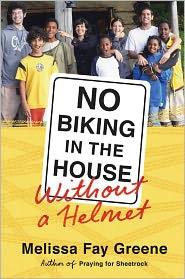
An exciting evening event in the library is coming up in about two weeks. On a Tuesday evening, award-winning author (and Paideia parent) Melissa Fay Greene will read from and talk about her latest book, No Biking in the House Without a Helmet.

The New York Times
wrote:
“It’s time for a laugh-out-loud selection … No Biking in the House Without a Helmet is a chance to revel in the joy that one wonderful writer takes in this messy, exhausting, life-changing process of parenthood."

Melissa and her husband are the parents of six sons and three daughters, and much of No Biking in the House chronicles the joys and chaos of growing from four to nine children through international adoption. If it's one thing a mother of four teenage boys ought to be good at, it's picking her battles -- hence the "without a helmet" clause. Even the best mom can't control everything (especially after the fact)!

With a crazy book tour schedule as well as a, shall we say, FULL home life, it took a while to coordinate with Melissa for this evening. As it is, I'm pleased that it will fall in the middle of National Adoption Month, a fine time to celebrate Paideia families of all stories and sizes.

Melissa Fay Greene is the author of several other acclaimed works of non-fiction, including two National Book Award finalists (Praying for Sheetrock and The Temple Bombing, about the historic bombing in Atlanta), There Is No Me Without You and Last Man Out (a New York Times Notable Book), and a contributing writer to numerous national publications (a piece on adopting from Africa is here on the All Things Considered website.)

Copies of No Biking in the House Without a Helmet will be available that evening for $26 (through Decatur bookstore Little Shop of Stories). A dessert reception and book signing will be held after Melissa's talk.

Wednesday, October 26, 2011

Classic Novels and Movies Collide in the eBook realm

These days I fear I dream about eBooks and how to include them in our Library offerings (actually, I don't fear it, I've really dreamed it. Yikes!) The vendor and platform market is in major flux, and I feel like Indiana Jones on a precipice with a herd of wildebeasts rushing towards, wanting to jump but having no clue which way to go (better than an army of ravenous red ants, but only a little bit). It's not the time to invest thousands of $$$ in one vendor, to find that in 6 months the subscription fee triples, and there's no 'ownership' of or rights to transfer eBooks we think we've 'bought.' Oi, these are good times to be a copyright lawyer!

I've begun to include classic (public domain) novels converted to eBooks (including Kindle and iBook readable formats) in our Surpass WebSafari catalog (search for keyword 'electronic books') -- the idea is, if a student is looking for Wilkie Collins' The Moonstone (taught every so often by Joseph Cullen), the eBook version will be listed in the catalog alongside the print version. There are dozens of iPads circulating around the high school, with numerous other eReader capable laptops & Kindles owned by or checked out by students. Our fabulous technology staffer Lauri Lee has created a spreadsheet of all high school textbooks with "E" options, which has made it simple to identify this semester's texts that are in the public domain, and available for free download.

If you don't yet know about Project Gutenberg, you should investigate now. Back in grad school, I heard Michael Hart speak about his endeavor to 'digitalize' all the world's public domain documents, and I'm now seeing this labor of dedication becoming useful to everyday students at Paideia School.

I believe that technology can give us ways to loan electronic books to users while still respecting the copyright owner's right for deserved gain/remuneration. We're just not quite there yet without hitching our wagons to a major vendor. Stay tuned -- this is important, and lord knows, with all the Kindle Touch and Fires destined for holiday giving, it's imminent.

Until then -- the inspiration for this post:

Two Princeton academics have launched a new eBook imprint that ties public domain eBooks and current movies. Scarlet Oak Press is making enhanced eBook editions of major films based on classic books that are coming out this fall and winter.

The enhanced editions include original introductions, an annotated study guide, maps and illustrations, as well as what Scarlet Oak Press is calling a “page-to-screen history.” This includes: 'The Three Musketeers' and 'The Best of Sherlock Holmes: Stories and Novels' both of which are coming out as films this fall, and Jules Verne‘s 'The Mysterious Island', Edgar Rice Burroughs ‘ A Princess of Mars,' which is the basis for Disney’s 'John Carter' and Edgar Allen Poe‘s 'Raven: Dark Tales from Poe.' All of the titles are $.99 in the Kindle store.
Or, if you want to sample the original novels before paying for "enhanced" versions, click on the links in the paragraph above for the Project Gutenberg downloadable ebooks (though 99¢ is a pretty reasonable gamble). I plan to dive into The Scarlet Pimpernel this weekend. Happy discovery!