Thursday, September 15, 2011

So Much More


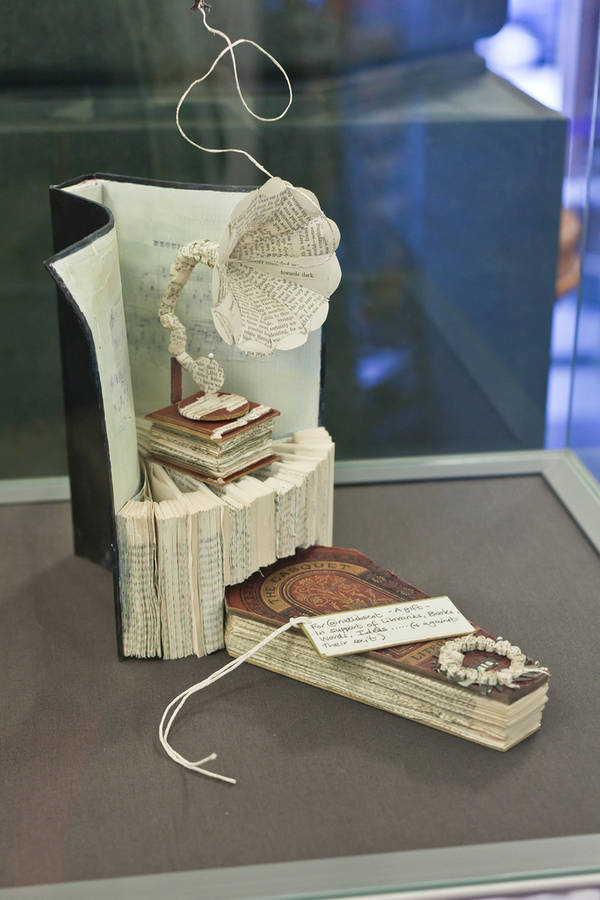
This morning, a student sent me an e-mail with a link to a series of mysterious and beautiful incidents happening in Scottish libraries this year. An anonymous (and very talented) artist has left intricately detailed paper sculptures in at least seven libraries, along with notes of encouragement and support. The first sculpture, found in the National Poetry Library, was left with this note:
... We know that a library is so much more than a building full of books… a book is so much more than pages full of words.… This is for you in support of libraries, books, words, ideas….. a gesture (poetic maybe?)
Though the word library has "book" at its very heart (liber = "book" in Latin), any library worth its salt is all about content rather than containers. A library's mission is to provide information/knowledge/content to its patrons, and the best way to do that is to collect and store the information in containers that patrons can use. The 21st century has swept in with a monumental shift in preferred containers - as digital books on CD-ROM, then as online texts that lived on the Internet. The current wave is bringing in digital texts that arrive through the Internet, but that live on and are accessed through devices that don't have to be connected in order to be read (Kindle, iPad/Pod/Phone).

I think that the discomfort of the "digital immigrant" population's resistance to the ever shortening tether to the Almighty Screen (my bias shines through, doesn't it??) is at its heart a worry about the quality of online content. Librarians and teachers fuss about the shallowness of content and how easy it is for users to find mediocre information online; on the other hand, we happily offer periodical databases and online journals and downloadable unabridged novels.

My struggle with the Almighty Screen is ongoing. I use and teach with a computer all day, the Internet is a go-to for all kinds of questions, deep and otherwise, and I LOVE my iPad. About half of my summer books got read as Kindle books, iBooks, or ePub books borrowed/downloaded from the Atlanta-Fulton Public Library. And yet I read with concern (with a Kindle app on my iPad) the huge volume of research data collected in Nicholas Carr's The Shallows: What the Internet is Doing to Our Brains, which very clearly demonstrates that the nature of electronic reading fundamentally changes our neurological pathways, and exercises very different areas of the brain than does print-on-paper reading. Carr argues that the medium IS the message, that the device determines how information is packaged and delivered. For every gain (ease and wealth of information, available to everyone, quickly) there is a loss or trade-off (we don't pay attention very well or for very long any more). Rolling the newspaper, a novel, an encyclopedia, your diary, the postal service, the typewriter, the television, the radio, and the video game console all into one portable device means potential for knowledge and potential for distraction everywhere, all the time, just a click or a flick away.

So many things are different and scary when content is separated from container. For librarians there are practical challenges -- how do we describe and store information for easy retrieval (ie, catalog) when it's not in a fixed container? How do we help people find and make sense of information when they don't have to come to the library for the container? How do we justify spending a large percentage of annual budgets to collect information that is available only as long as we pay the vendor and the electricity bill? How will artists create art out of books, if there are no books?

The Kindle experiment last spring gave rise to my "content not container" philosophy, and -- contrary to trends in many other excellent school libraries -- we're not going into the business of loaning eReaders. We will be looking to start loaning content for our students and faculty to read via their container of choice - be it a Kindle, an iPad, a Nook or a Netbook. I am looking forward to Amazon.com's upcoming launch of their library-loanable Kindle books (I like the way Amazon's Kindle app makes their Amazon-only books readable on many devices other than just Kindles).

The criteria for choosing the content will be the same as ever -- high-quality content that meets the personal and educational information needs of the Paideia community. Fiction, non-fiction, audiobooks, eBooks, print books too. And our daily work will remain the same -- to teach (guide, lead, coach, accompany) students and faculty to find, evaluate and use the desired information. Some things don't have to change.

Libraries are, and should always be, so much more than than buildings full of book.

Monday, June 13, 2011

Read This Book:
Guardian of the Dead by Karen Healey

The first several times I saw reviews of this book, I thought it sounded interesting but didn't put it on the library order list. Why? Just another mythological fantasy, strong female character, there are a million of them. I passed it by.

A few weeks ago another review came my way, and this time I decided to forge ahead and read it. I'm glad I did.

Guardian of the Dead is by a New Zealander, and is firmly placed in current day New Zealand. Ellie Spencer is spending her senior year in a boarding school in Christchurch (South Island) while her parents enjoy a year-long trip around the world. She's got a solid friendship with popular golden boy Kevin, a crush on a mysterious misfit, and a black belt in tae kwon do ( though with no time to practice in boarding school, she's gained a few pounds).

One of the really neat aspects of the book is the blending of European faerie traditions (the action gets going when Ellie becomes involved with a production of A Midsummer Night's Dream) and native New Zealand Maori creation mythology. Familiar, yet new and unknown, the author provides an afterword with more information about Maori tradition, her sources, and the ways in which she was faithful to and strayed from the recorded stories. Story is a big part of the novel, not just cultural traditions, but each individual's personal story -- who they are, what they've done, and how they frame this to themselves and others. Recognizing her ability to shape her own story gives Ellie the insight to make her way through the challenges presented by the opposing powers.

Ellie is utterly normal, admirable, appealing but not perfect. She's tall so she slouches, she's broken more than a few school rules but that's not the defining part of her character. She compares herself unfavorably to more perfectly gorgeous girls, but she's not down on herself because of it. She's a loyal friend but not a doormat. She's strong, and she knows it. As she discovers her magical powers (of course there are magical powers!) she learns that there are right and wrong ways to use them, and she sticks to her moral compass as her powers grow.

There were several times when I thought I knew where the plot was headed, only to be surprised by the appearance of strange and unfamiliar characters, a twist or new development that took the novel off in a different direction. Even the North Island ending, with overt elements of Greek mythology (Hades and Persephone, Orpheus and Eurydice), wasn't at all what I anticipated, but it's completely true to the rest of the story.

Something that, to me, makes this novel even better is that the characters are a mix of races and backgrounds, not as token elements but as a feature of contemporary life. There is discussion of race, of passing (as European) or not, of discrimination against the Maori. Ellie's mom is a cancer survivor (hence the celebratory world trip), but it's not a book about cancer. Her older sister in Melbourne is lesbian, her parents are not entirely comfortable with this, but it's not a book about gay rights. It's just how the world is, and it feels right to have it reflected in this way.

Guardian of the Dead has won a ton of awards, Antipodean as well as American. If you like slightly creepy urban fantasy, reworkings of classical and world mythology, a touch of romance, or just like to explore other cultures through literature, Guardian of the Dead is a worthwhile investment of your reading time.

Monday, June 6, 2011

More Reading Recommendations

The Elementary Summer Reading List is now online. Whether you're looking for picture books for your babysitting clients, great gifts for little ones, or wanting to catch up on great children's novels you might have missed, the Elementary list is for more than just the K-6 set. Click on the cover image to download the PDF edition of the Elementary list now.

There is no way that any one list (or even three awesome annotated school lists) can include all the good books that are worth reading over a summer. Even the big name lists don't all agree! So in the event that you are still looking for reading suggestions, you may enjoy the articles below:

The Stars of Modern SF Writers Pick the Best Science Fiction (in The Guardian)

Summer Fiction: Around the World in 24 Books (in The Telegraph)

Books to Bury Yourself In (in The New York Times)

Friday, May 27, 2011

Summer Reading Lists Are Out

Seems like I say the same thing every year ("gosh, can't believe it's time already . . ."). So with no further ado, the Elementary, Junior High and High School summer reading lists have all either been distributed (current K-6th graders) or mailed (7th-11th graders, and all new students). They should have hit mailboxes by yesterday, or possibly as late as today.

* Each reading list link will download a full-size PDF of the booklet

A word about our summer reading "requirement" -- yes, we absolutely require summer reading, but we don't specify what must be read. The reading lists for all levels are for guidance, entertainment, education, but not limitation -- there are so many good books that a student might not find on her own, and the lists include hundreds, if not thousands of recommendations. There are also too many zillions of good books to fit them all into one 40 page booklet, so the odds are good that a student will have one or more books on his "must read" list that isn't in the booklet. No problem! Does it have words? Ideas? A more or less sustained narrative? Then it probably counts. If in doubt, e-mail me or Natalie with your question, or ask your teacher.

To support and encourage students in finding a reading passion, we open the collection for summer checkouts at the end of each school year. Families may check out up to 40 books, which will all be due when school starts back in the fall. Because of the number of materials and the length of the summer, we require a parent to be responsible for the books and check them out on parent accounts. Elementary students must come in with a parent, while high school and junior high students may select and check out books on their parent's account as long as they have permission from the parent (a note, e-mail or phone call to me works).

Come on in and choose a stack. If you're overwhelmed or stumped for choices, arrange for a "Personal Consultation" with a librarian -- it's sort of like having a Personal Shopper for books, only it's free!

ps -- the downloadable Elementary list will be ready next week.

Friday, May 20, 2011

Prepare for the Zombocalypse!


Well, folks. It's official -- the CDC has issued its preparedness checklist for the Zombie Apocalypse. Personally, I've never quite "gotten" the zombie thing -- they're dead AND rotting, their dinner choices are parts that most Westerners don't eat anymore, their conversational skills are nil, and they're not even into fashion, ice cream or good books. At least vampires can clean up and retract their fangs . . .

But I digress. It's true about the CDC's preparation advice. From the CDC Social Media blog:
There are all kinds of emergencies out there that we can prepare for. Take a zombie apocalypse for example. That’s right, I said z-o-m-b-i-e a-p-o-c-a-l-y-p-s-e. You may laugh now, but when it happens you’ll be happy you read this, and hey, maybe you’ll even learn a thing or two about how to prepare for a real emergency.
Turns out, all the steps folks should take to prepare for Zombocalypse are the same things we should do to prepare for a tornado, hurricane, or flood. Who knew, a little pre-planning can kill multiple natural disaster birds with one stone!

Of course, if you want to study up on all the ways a zombie invasion could come about, we've got plenty of choices here in the library (mostly in the fiction section . . ).


Non-Fiction

And if you want to cover all the possibilities:


If you're ready for a zombie apocalypse, then you're ready for any emergency. emergency.cdc.gov

Meet you at the mailbox.

Monday, May 16, 2011

Books, Altered - Now Showing in the Library

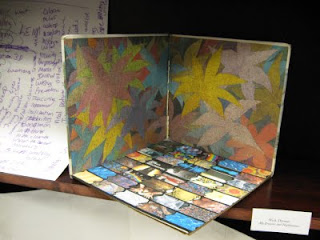
It was great timing. Elizabeth Lide's Drawing and Design art class mounted a display of their Altered Books projects the week before the 40th Anniversary book release party here in the library. Books everywhere!

A few students used outdated Encyclopedia Britannica volumes (we recently got a newer edition), and incorporated the volumes' content (trees, in the T volume, and a bridge in the B volume) into the artwork.


Other pieces were created from baby board books, a telephone book, and a hardback copy of Where the Wild Things Are.

Outside
Wild things


Cover


nightmares


One student altered a collection of paper plates with recipe pages from an international cookbook, overlaid with hand-cut block prints, culminating with a meal of international foods from the represented countries.


A final piece defies attempts at photography. Called Shadow Puppets, it's an interactive work created from a deconstructed board book overlaid with translucent vellum. In order to see the work (images of various hand puppet shapes, including the beloved two-fingered long ear bunny rabbit), the viewer has to slide a dark background behind each shape. And magically, the shadow puppets appear.

For inspiration on creating altered book art, visit the links in this post from the DeKalb County Public Library ("Can't Do That With An eBook") featuring Atlanta artist Brian Dettmer, and Part II. A CBS piece on Dettmer aired just last night -- watch the 2.5 minute clip here.

For techniques and inspiration for creating art from a variety of objects, check this book out of our library:


Altered Art: Techniques for Creating Altered Books, Boxes, Cards and More by Terry Taylor.