Monday, June 6, 2011

More Reading Recommendations

The Elementary Summer Reading List is now online. Whether you're looking for picture books for your babysitting clients, great gifts for little ones, or wanting to catch up on great children's novels you might have missed, the Elementary list is for more than just the K-6 set. Click on the cover image to download the PDF edition of the Elementary list now.

There is no way that any one list (or even three awesome annotated school lists) can include all the good books that are worth reading over a summer. Even the big name lists don't all agree! So in the event that you are still looking for reading suggestions, you may enjoy the articles below:

The Stars of Modern SF Writers Pick the Best Science Fiction (in The Guardian)

Summer Fiction: Around the World in 24 Books (in The Telegraph)

Books to Bury Yourself In (in The New York Times)

Friday, May 27, 2011

Summer Reading Lists Are Out

Seems like I say the same thing every year ("gosh, can't believe it's time already . . ."). So with no further ado, the Elementary, Junior High and High School summer reading lists have all either been distributed (current K-6th graders) or mailed (7th-11th graders, and all new students). They should have hit mailboxes by yesterday, or possibly as late as today.

* Each reading list link will download a full-size PDF of the booklet

A word about our summer reading "requirement" -- yes, we absolutely require summer reading, but we don't specify what must be read. The reading lists for all levels are for guidance, entertainment, education, but not limitation -- there are so many good books that a student might not find on her own, and the lists include hundreds, if not thousands of recommendations. There are also too many zillions of good books to fit them all into one 40 page booklet, so the odds are good that a student will have one or more books on his "must read" list that isn't in the booklet. No problem! Does it have words? Ideas? A more or less sustained narrative? Then it probably counts. If in doubt, e-mail me or Natalie with your question, or ask your teacher.

To support and encourage students in finding a reading passion, we open the collection for summer checkouts at the end of each school year. Families may check out up to 40 books, which will all be due when school starts back in the fall. Because of the number of materials and the length of the summer, we require a parent to be responsible for the books and check them out on parent accounts. Elementary students must come in with a parent, while high school and junior high students may select and check out books on their parent's account as long as they have permission from the parent (a note, e-mail or phone call to me works).

Come on in and choose a stack. If you're overwhelmed or stumped for choices, arrange for a "Personal Consultation" with a librarian -- it's sort of like having a Personal Shopper for books, only it's free!

ps -- the downloadable Elementary list will be ready next week.

Friday, May 20, 2011

Prepare for the Zombocalypse!


Well, folks. It's official -- the CDC has issued its preparedness checklist for the Zombie Apocalypse. Personally, I've never quite "gotten" the zombie thing -- they're dead AND rotting, their dinner choices are parts that most Westerners don't eat anymore, their conversational skills are nil, and they're not even into fashion, ice cream or good books. At least vampires can clean up and retract their fangs . . .

But I digress. It's true about the CDC's preparation advice. From the CDC Social Media blog:
There are all kinds of emergencies out there that we can prepare for. Take a zombie apocalypse for example. That’s right, I said z-o-m-b-i-e a-p-o-c-a-l-y-p-s-e. You may laugh now, but when it happens you’ll be happy you read this, and hey, maybe you’ll even learn a thing or two about how to prepare for a real emergency.
Turns out, all the steps folks should take to prepare for Zombocalypse are the same things we should do to prepare for a tornado, hurricane, or flood. Who knew, a little pre-planning can kill multiple natural disaster birds with one stone!

Of course, if you want to study up on all the ways a zombie invasion could come about, we've got plenty of choices here in the library (mostly in the fiction section . . ).


Non-Fiction

And if you want to cover all the possibilities:


If you're ready for a zombie apocalypse, then you're ready for any emergency. emergency.cdc.gov

Meet you at the mailbox.

Monday, May 16, 2011

Books, Altered - Now Showing in the Library

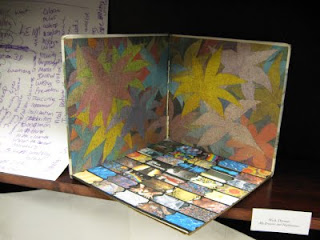
It was great timing. Elizabeth Lide's Drawing and Design art class mounted a display of their Altered Books projects the week before the 40th Anniversary book release party here in the library. Books everywhere!

A few students used outdated Encyclopedia Britannica volumes (we recently got a newer edition), and incorporated the volumes' content (trees, in the T volume, and a bridge in the B volume) into the artwork.


Other pieces were created from baby board books, a telephone book, and a hardback copy of Where the Wild Things Are.

Outside
Wild things


Cover


nightmares


One student altered a collection of paper plates with recipe pages from an international cookbook, overlaid with hand-cut block prints, culminating with a meal of international foods from the represented countries.


A final piece defies attempts at photography. Called Shadow Puppets, it's an interactive work created from a deconstructed board book overlaid with translucent vellum. In order to see the work (images of various hand puppet shapes, including the beloved two-fingered long ear bunny rabbit), the viewer has to slide a dark background behind each shape. And magically, the shadow puppets appear.

For inspiration on creating altered book art, visit the links in this post from the DeKalb County Public Library ("Can't Do That With An eBook") featuring Atlanta artist Brian Dettmer, and Part II. A CBS piece on Dettmer aired just last night -- watch the 2.5 minute clip here.

For techniques and inspiration for creating art from a variety of objects, check this book out of our library:


Altered Art: Techniques for Creating Altered Books, Boxes, Cards and More by Terry Taylor.

Wednesday, April 20, 2011

Room of Their Own


Something I've been thinking about doing for a while, but was finally spurred on to do this week when an entire JH class, starting a writing unit on graphic narratives, came in to check out graphic novels.

Though it's quite possible to give Dewey or Library of Congress call numbers to every single item in a library and line them up consecutively on the shelves, there are all kinds of ways to organize library materials that make more sense: for example, by format (having different sections & call numbers for DVDs, audio books, and print books); by genre/subject (B for Biography, V for Videos, Dewey numbers for Non-Fiction); or by size (a special Oversize section for those pesky tall books). The danger lies in having so many separate sections that the library becomes too much like a bookstore, all higgledy-piggledy and hard to find things in.

Graphic novels are usually classified with the Dewey Decimal number 741.5 (Drawing and decorative arts->Cartoons, caricatures, comics), together with books on how to draw comics, analyze comics, the history of comics, and comic strip collections (like Snoopy and Garfield). Readers who love graphic novels are intrigued by the format and will read broadly across subject areas -- biography, fiction, fantasy, history. Since we have a pretty decent-sized collection that's growing in popularity, it was time to pull the graphic narratives into a separate and easy-to-find area.


This corner in the magazine/reading/coffee table area of the library is high visibility and gets a lot of browsing, so even more students may now be hooked by the allure of graphic novels.

Whether you're a fan of graphic novels, or just curious, come by to browse the collection, or check this list to see what we've got for you.


ps -- for the time being, I'm going to leave the call numbers as they are. Coming up with a new section designation and printing new spine labels is a project for later, when this new section is settled.

Tuesday, April 12, 2011

Kindles in the Library, Redux

Finally, a compelling reason (for me, at least) to have library-owned Kindles to loan.

Back in February, the Library got its first Kindle eReader. I played with it for a few days, and was underwhelmed (lots of thoughts, written up in this post). Since then, two teachers and one student have "test-read," with mixed reactions. I'm not sure what it says that none of the three actually finished the book that was requested and loaded on the Kindle for them.

For both teachers/adults -- one was reading a book to prep for class, the other was reading a novel for fun at the beach -- the biggest frustration with the electronic device was the inability to flip back and forth through the pages, or to create a visual memory of how far along in the book a certain scene takes place. Taking notes isn't really that easy either. The student said he got used to it and liked it a lot, but didn't have much time for pleasure reading during the semester. I'd pretty much come to the conclusion that eReaders really are best as "personal electronics," and that it still makes more sense for libraries to loan content rather than devices.

And then last week, a student asked for an audiobook of Makes Me Wanna' Holler, a non-fiction title he is reading in class. Sure! we have audiobooks, specifically for students who learn as well or better through their ears than eyes. Only not this one, and it's apparently not available on CD (or even Audible.com), only on cassette, used. Even worse, the cassette edition is abridged. Even if I were to buy it, which I didn't want to do, it would be of limited value. The teacher came to ask how we can support this student. Think think, ponder ponder. The Kindle was sitting on my desk, just returned from its spring break checkout. Eureka!! (or, like DUH) What about the Kindle text-to-speech function I'd heard about? How good/awful is it? Could this be an option?

A quick check confirmed that the needed book was "text-to-speech enabled" (some copyright holders have demanded disabling of this function, concerned about potential impact to audiobook sales). Note sent to the next teacher on the Kindle test-drive list explaining the delay (gulp, it's the Headmaster.) Book purchased, downloaded and device ready to be checked out by break. The Kindle has a jack for headphones, and after class (the one reading the book), this student was already so enthusiastic he asked if we had his lit book on audio! Downloaded and ready by the end of the day. So now the one Kindle is helping this student in two classes, and providing something that the print editions of both books just can't do.

Having a computer read out loud to you is not the greatest aesthetic experience with a book. There's even inadvertent humor involved -- when it comes to tricky stuff (as in ALL the cuss words), I'm told the Kindle just spells them out! I bet that was a lively discussion at the Amazon.com product development meetings.

Still, text-to-speech is high-level value added in my opinion, making the Kindle more than just another way to read a book. (Paul B., the Library's second Kindle will be here later this week, and you're still first on the list.) I'm also going to participate in the Technology department's new iPad test program -- with a less expensive, refurbished 1st generation iPad (w/o cameras) -- to see if offers value to students in a library-relevant way. Brief research indicated that iBook can be set up as a text-to-speech device for Apple bookstore ebooks, though the Kindle reader app doesn't have the function. We'll see.