I've created a Blogger page as a class outline for presenting science research methods and sources to Larry's DuPont Challenge and Science Fair short term classes. Link to this page below.
Researching Science Information On the Web
Showing posts with label Sites for Researchers. Show all posts
Showing posts with label Sites for Researchers. Show all posts
Friday, January 10, 2014


Thursday, September 15, 2011
So Much More
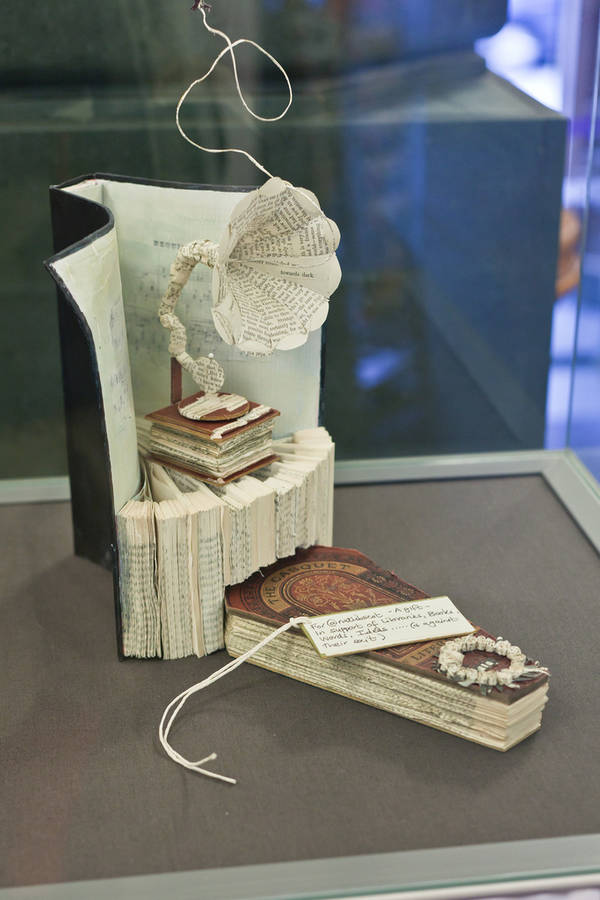
This morning, a student sent me an e-mail with a link to a series of mysterious and beautiful incidents happening in Scottish libraries this year. An anonymous (and very talented) artist has left intricately detailed paper sculptures in at least seven libraries, along with notes of encouragement and support. The first sculpture, found in the National Poetry Library, was left with this note:
... We know that a library is so much more than a building full of books… a book is so much more than pages full of words.… This is for you in support of libraries, books, words, ideas….. a gesture (poetic maybe?)Though the word library has "book" at its very heart (liber = "book" in Latin), any library worth its salt is all about content rather than containers. A library's mission is to provide information/knowledge/content to its patrons, and the best way to do that is to collect and store the information in containers that patrons can use. The 21st century has swept in with a monumental shift in preferred containers - as digital books on CD-ROM, then as online texts that lived on the Internet. The current wave is bringing in digital texts that arrive through the Internet, but that live on and are accessed through devices that don't have to be connected in order to be read (Kindle, iPad/Pod/Phone).
I think that the discomfort of the "digital immigrant" population's resistance to the ever shortening tether to the Almighty Screen (my bias shines through, doesn't it??) is at its heart a worry about the quality of online content. Librarians and teachers fuss about the shallowness of content and how easy it is for users to find mediocre information online; on the other hand, we happily offer periodical databases and online journals and downloadable unabridged novels.
 My struggle with the Almighty Screen is ongoing. I use and teach with a computer all day, the Internet is a go-to for all kinds of questions, deep and otherwise, and I LOVE my iPad. About half of my summer books got read as Kindle books, iBooks, or ePub books borrowed/downloaded from the Atlanta-Fulton Public Library. And yet I read with concern (with a Kindle app on my iPad) the huge volume of research data collected in Nicholas Carr's The Shallows: What the Internet is Doing to Our Brains, which very clearly demonstrates that the nature of electronic reading fundamentally changes our neurological pathways, and exercises very different areas of the brain than does print-on-paper reading. Carr argues that the medium IS the message, that the device determines how information is packaged and delivered. For every gain (ease and wealth of information, available to everyone, quickly) there is a loss or trade-off (we don't pay attention very well or for very long any more). Rolling the newspaper, a novel, an encyclopedia, your diary, the postal service, the typewriter, the television, the radio, and the video game console all into one portable device means potential for knowledge and potential for distraction everywhere, all the time, just a click or a flick away.
So many things are different and scary when content is separated from container. For librarians there are practical challenges -- how do we describe and store information for easy retrieval (ie, catalog) when it's not in a fixed container? How do we help people find and make sense of information when they don't have to come to the library for the container? How do we justify spending a large percentage of annual budgets to collect information that is available only as long as we pay the vendor and the electricity bill? How will artists create art out of books, if there are no books?
The Kindle experiment last spring gave rise to my "content not container" philosophy, and -- contrary to trends in many other excellent school libraries -- we're not going into the business of loaning eReaders. We will be looking to start loaning content for our students and faculty to read via their container of choice - be it a Kindle, an iPad, a Nook or a Netbook. I am looking forward to Amazon.com's upcoming launch of their library-loanable Kindle books (I like the way Amazon's Kindle app makes their Amazon-only books readable on many devices other than just Kindles).
The criteria for choosing the content will be the same as ever -- high-quality content that meets the personal and educational information needs of the Paideia community. Fiction, non-fiction, audiobooks, eBooks, print books too. And our daily work will remain the same -- to teach (guide, lead, coach, accompany) students and faculty to find, evaluate and use the desired information. Some things don't have to change.
Libraries are, and should always be, so much more than than buildings full of book.
Monday, February 21, 2011
The Real Life Value of Research

Today's New York Times reports that the last six unidentified victims of the 1911 Triangle Shirtwaist Factory fire have been named, and at the centennial commemoration on March 25, the names of all 146 who died in the fire will be read aloud for the first time.
A complete list of the 146, mostly female, victims was never created until now. The most thorough list to date was published in 2003 by David Von Drehle in his book Triangle: The Fire That Changed America, which included 140 names. At the time of the fire, 6 bodies were so badly charred that they could not be recognized; families who believed their loved ones had died in the fire could not positively claim the deceased, and those names were never included on official lists. The six "unknowns" were buried in the Cemetery of the Evergreens. As the Times writes,
"the obscurity of their names is evidence of the times, when lives were lived quietly and people were forced by economic and familial circumstances to swiftly move on from tragedies."
Good old-fashioned research is what put the remaining 6 names on the list. Historian Michael Hirsch became interested in the fire because one of the victims had live on his street. Over a period of four years, he dove into primary source research, looking in over 30 newspapers from 1911 (some which had to be translated from Yiddish and Italian) for articles about families still missing relatives who had worked at the factory. Once he had names, he was able to go to census records, marriage licenses, and union charity records (more primary sources) to verify or eliminate those names from his list. He was finally able to contact descendents of three of the six, and found that those families mourn their ancestors as victims of the fire, though their names were not included among the dead.
I first became aware of the Triangle Shirtwaist Factory fire (known at the time as the Washington Place fire, for the factory's address) a couple of years ago when a student chose it as her American History research paper topic. It's a crucial turning point in labor laws, building codes and women's history, as outrage about working conditions and the fact that firemen found all the stairwell and exit doors locked, preventing employees from leaving before quitting time (and trapping them in the fatal inferno) mobilized public opinion for change. Another student is researching the same topic this year.
Mr. Hirsch's research will be part of the HBO documentary Triangle: Remembering the Fire produced in commemoration of the 100th anniversary of the tragedy (the DVD, a great secondary source, will be added to our library as soon as it's released).
A reminder that even when your research topic happened 100 years ago, new information is always possible. History often slows down, but it's never quite over.
Read more about the Triangle Shirtwaist Factory Fire
Triangle: The Fire That Changed America by Dave von Drehle
The Triangle Shirtwaist Fire and Sweatshop Reform in American History by Suzanne Lieurance
The Triangle Fire by Leon Stein
Threads and Flames: A Novel by Esther Freisner
Remembering the Triangle Factory Fire
(website at Cornell's Keel Center for Labor Management)
Articles from the New York Times, March 25-April 3, 1911
(via ProQuest Historical Newspapers; you will need ProQuest ID & password for off-campus access)

Wednesday, September 8, 2010
Wednesday Website:
Open Culture

This one is for all the life-long learners out there. Subtitled "the best free cultural & educational materials on the Web," Open Culture is a project of Dan Coleman, the Director & Associate Dean of Stanford's Continuing Studies Program. As he describes it:
Open Culture brings together high-quality cultural & educational media for the worldwide lifelong learning community. Web 2.0 has given us great amounts of intelligent audio and video. It’s all free. It’s all enriching. But it’s also scattered across the web, and not easy to find. Our whole mission is to centralize this content, curate it, and give you access to this high quality content whenever and wherever you want it. Free audio books, free online courses, free movies, free language lessons, free ebooks and other enriching content — it’s all here. Open Culture was founded in 2006.
There are other sites that pull together great educational materials. Many top notch colleges and universities such as MIT and UC Berkeley post readings, syllabi, and video or audio lectures for many of their most popular classes through Open CourseWare projects or iTunes U. TED posts videos of its inspiring and thought-provoking talks on its website for the world to view. Free Technology for Teachers is an award-winning collection of all kinds of freely available websites, with ideas on how they can be used to benefit student learning. I love them all, but a very nice thing about Open Culture is that it's very inclusive in topics and formats, which makes it an awesome place to start.
Students who want extra help, or to learn a language not taught at Paideia, there are links for you. Want to go further into Roman Architecture than you did in World Civ? Learn from a professor at Yale. Psyched to travel, or catch up on the classics of literature? Open Culture links to 20 different top quality travel podcasts and dozens of free audiobook classics you can download to your iPod. And the blog has daily posts that link to all kinds of just really cool stuff -- on Monday it led to a transcript of a 1939 lecture by Alfred Hitchcock on the art of suspense, a great find for all film buffs with hungry minds.
Being a school librarian is a great outlet for a hungry mind. As we work to satisfy student learning needs, we get to learn at the same time. And then pass it on. If Paideia students graduate into a vocation as life-long learners, we'll have done our jobs well.
Wednesday, September 1, 2010
Wednesday Websites:
For Journalism Students (and everyone else)

On Tuesday I talked with the staff of The Forum in Jennifer Hill's journalism class, about Internet research, finding reliable web sources, and fact checking. As I prepared, it occurred to me that all of these skills are the same techniques that all students should be using for their classes and for their personal information needs. Teachers and other grownups would benefit from researching like a journalist as well.
In class we went over a few main points:
- using websites dedicated to verifying (or debunking) political and social rumours, urban legends, chain mail claims, and the like (Snopes.com, PolitiFact.com, and others)
- Google is fine, but use the power tools (+, - and "") to get better quality searches. Consider that Google hits may be weighted in various ways, and go beyond the first few to find more solid sources. Use clues from blogs or Wikipedia to lead you to the information in quality sources. Double-check all facts by finding the same information in one or more quality source (CNN, US government website, primary source, etc).
- make sure that multiple sources are actually different sources (not just the same Wikipedia article in different websites). Do your sources all quote the same primary source? Find the primary source yourself.
- use the Paideia databases (SIRS and ProQuest) as a way to find sources (reports & articles, including AJC archives back to 2002) that have been through some sort of filtering process before being included. CQResearcher has comprehensive reports on current social and political issues
- questions to ask of any website in deciding whether it's reliable enough to stake your journalistic reputation (or grade) on its content
Links to all of the websites mentioned in the session are on PiLibrarian's Recommended Websites list, with the tag Journalism.
Tuesday, April 13, 2010
National Poetry Month Resources
 If ever there was a national celebration made for literature teachers, this is it. So many resources, so many opportunities for total immersion in poetry. One of our high school teachers is asking her students to read a poem a day and respond to it in a writing journal, so I pulled together a list of web sources that will make it easy for students to find a new and different poem each night. Most of these sites also have some way to subscribe so the daily poem comes right to your e-mail or newsreader. How cool is that?
National Poetry Websites
- Poetry Foundation.org (site of Poetry magazine)
- Poetry Daily (a new poem each day)
- Poetry 180 - a poem a day for High School students , from the Library of Congress
- Favorite Poem Project -- Americans reading their favorite poems out loud, begun in 1997 by former Poet Laureate Robert Pinsky
- Poets.org -- Academy of American Poets Poem a Day archive
- Poetry Out Loud - resource site for a poetry recitation competition, sponsored by the National Endowment for the Arts & the Poetry Foundation
- Poem-a-Day from Knopf
- Writing and Ruminating - blog of children's author Kelly Fineman; lots of poetry analysis, link is to poetry posts
- I'm Here, I'm Queer, What the Hell Do I Read? - blog of YA author Lee Wind; link is to GLBTQ poem posts
- 30 Poets, 30 Days at Gottabook blog -- daily posts with a previously unpublished poem by a young adult or children's author, including many by authors of col
The New York Times Learning Network:
"11 Ways to Celebrate National Poetry Month with the New York Times"
Monday, February 15, 2010
CQ Researcher Reports:
an information goldmine

This showed up in my e-mailbox this morning:
Sleep Deprivation:
Are chronically tired people at greater health risk?
via CQ Researcher Online
New research links sleep deprivation to a large number of automobile and other accidents. Moreover, chronically sleep-deprived people are at higher risk for poor memories, mental illnesses, obesity, cardiovascular disease and early death. Yet today's 24/7 culture fights against the human body's biological need for about seven hours of sleep a night. Some people are especially sleep deprived, notably teenagers and late-shift workers such as police officers, nurses and medical residents. Meanwhile, some experts worry that overuse of sleeping medications is becoming a serious problem. Newer medications like Ambien and Lunesta are in some ways “safer” than older drugs, but they also affect brain function and sleep patterns in ways that are still not fully understood. With primary-care doctors now able to prescribe these medications because of their greater apparent safety, more people may get into trouble with sleeping pills.
This is the weekly report announcement from CQ Researcher, one of our awesome online subscription databases. It comes from a company that got its start preparing background reports on issues coming up in the US Congress; CQ stands for "Congressional Quarterly." Each weekly report is a 24-32 page goldmine of information on some hot national issue, and includes an overview introduction, background information, a timeline, a Pro/Con debate on some question related to the topic ("Should medical residents' work hours be further limited to allow more time for sleep?"), and lots of citations to sources for further research. Some of these citations can even be gotten by going right over to ProQuest or SIRS Researcher, library databases of magazine and newspaper articles.
Recent CQ Researcher (and its monthly companion CQ Global Researcher) reports include:
Press Freedom: Should partisan bloggers get free-press protections?
Professional Football: Is the NFL doing enough to protect players?
Housing the Homeless: Is the solution more shelters or affordable housing?
Climate Change: Will the Copenhagen Accord slow global warming?
Truth Commissions: Can countries heal after atrocities?
If there is a relatively recent Researcher report on your topic, you have hit the mother lode!! Though the full-text of every report is available as a web page, I teach students that the easiest way to access the report is by downloading the PDF file to the computer; page 2 of the pdf always contains an annotated table of contents that helps a student get right to the good stuff.
From on campus, students can go directly to CQ Researcher Online, no passwords needed. For parents, or from home, a Paideia user ID and password are necessary -- see the librarians or go to the Library database page for the Database Help login link (use the @Paidia login info).
Want to keep on top of all the latest reports? You can subscribe to the E-mail Alert newsletter and get a weekly e-mail like the one I got this morning, or subscribe to the
 RSS feed (I use GoogleReader), using the orange RSS button at the top of the CQ Researcher home page.
I cannot enthuse enough about this wonderful resource! Solid, sophisticated coverage written for regular people, the CQ family of reports is a great way to research a topic or just learn more about the issues facing out nation and the world.
Friday, January 29, 2010
Fun with Bibliographies!

"How is this possible?" you think. Doing bibliographic citation correctly is quite possibly the most detail-ridden, hard to remember, big-picture useless skill learned in school. It will not make anybody more money in their next lives (the ones after high school) nor get them a date to the Bash. But in the past few weeks I have loved seeing students' faces light up in joy over a beautifully displayed MLA-formatted bibliography.
The magic word is NoodleBib. Last fall the library subscribed to the online research helper, and I've been preaching its merits ever since. Many students had already been using free online services to create their "Works Cited" or "Sources Used" pages -- EasyBib is one, BibMe is another. There is also a free version of NoodleBib.
The paid subscriber version is superior to the free versions, though, in that students create personal accounts so they can save their citations to edit, add to and print in the future. Plus, subscription NoodleBib includes note-taking and organization capabilities, a way to make an outline of your research, "virtual" notecards that can be tagged, sorted and moved around into subject piles -- it brings back memories of doing exactly this with stacks of real index cards, back in the olden times when I was in college. At 3 am, in the science center. Existentialism, was it? or the Spanish Civil War? Doesn't matter which paper -- with NoodleBib students can create and work on multiple projects, keeping all the citation and notes in separate lists. Individual lists can be shared online with the course teacher, who can track and comment on the student's research process well before the final product is due.
On Monday, both sections of Cullen's 10th grade American History classes came in for a library work day. I had done a full period presentation to his upper level classes last fall, when they were working on their French Revolution research, but for this class time was short. Cullen couldn't give both an "information" day and a "hands-on" day, so we came up with a solution that worked, both in theory and in execution. They came to the library, and while some students looked for sources and others worked with Cullen, I worked at the computer station with small groups of 4-6 students at a time. We went step-by-step through setting up a NoodleBib account and entering a citation and annotation, required for the assignment due in 2 days. Talk about "urgent need to know."
At the final step, "save as Word document,", those faces lit up. A perfectly formatted, alphabetized and printable bibliography. Truly a thing of beauty.
"This is SO cool!"
"This is awesome!"
I love my job.
Thursday, January 4, 2007
Search the World's Libraries with WorldCat
After you've checked the Paideia Library catalog (whether for a specific item, or for anything we may have on your topic), don't go directly to a bookstore -- try a search with WorldCat. This is a project of the venerable OCLC, one of the pioneers in computerized library catalogs.
Click on any of the results that look promising, and you'll find a box to enter your zip code. WorldCat will show you which nearby public and/or university libraries own the item you need. Maybe the Atlanta-Fulton County or DeKalb libraries, or Emory, Georgia State or Agnes Scott. Try it for yourself in the search box below. Have fun with it!
Click on any of the results that look promising, and you'll find a box to enter your zip code. WorldCat will show you which nearby public and/or university libraries own the item you need. Maybe the Atlanta-Fulton County or DeKalb libraries, or Emory, Georgia State or Agnes Scott. Try it for yourself in the search box below. Have fun with it!
Wednesday, December 13, 2006
All Darwin, All the Time

The name pretty much says it all. This site is a production of the University of Cambridge. It's got Darwin's complete publications with facsimiles of every page in every book (even the advertisements), plus manuscripts, reviews, mp3s and more. And (!) the entire collection is searchable.
The Complete Work of Charles Darwin Online is here.
Thanks to LibrarianInBlack for the lead on this valuable new site.
Tuesday, February 22, 2000
Triangle Fire, primary source articles from the NYT
New York Times articles about the Washington Place fire, March 26-April 3, 1911
(no passwords needed from campus; to access off-campus, use ProQuest database ID & password)
(no passwords needed from campus; to access off-campus, use ProQuest database ID & password)
- DEATH LIST SHOWS FEW IDENTIFIED; Eight Have Died in Three Hospitals of Injuries Received by Jumping to the Street. 33 INJURED STILL SURVIVE Pay Envelopes Brought About the Identification of Some of the Victims -- The Missing List.
New York Times (1857-1922). Mar 26, 1911. p. 4 (1 page)
- PARTNERS' ACCOUNT OF THE DISASTER; Blanck and Harris Tell of Their Escape in the Maddened Throng of Employes. CHILDREN OF ONE THERE Fled to the Roof When Other Avenues Were Cut Off and Thus Escaped with Their Lives.
New York Times (1857-1922). Mar 26, 1911. p. 4 (1 page)
- QUICK GRAND JURY FIRE INVESTIGATION; District Attorney, a Witness of the Horror, Takes Steps for an Immediate Inquiry. CONFERS WITH CHIEF CROKER Fire Department Head Says All Loft Buildings, Once Tenanted, Are More or Less Fire-Traps.
New York Times (1857-1922). Mar 26, 1911. p. 5 (1 page)
- CROWD OF 50,000 WATCHES THE RUINS; Press Against Police Lines All Day for Glimpse of Building Where So Many Died. MANY TRINKETS PICKED UP Some Money Dropped by Victims Also Found in the Street and in the Burned Building.
New York Times (1857-1922). Mar 27, 1911. p. 3 (1 page)
- FIRE TRAPS THERE ARE HERE.; Cloak Trade Committee Tells of Violations It Found. Scenes During and After the Washington Place Fire.
New York Times (1857-1922). Mar 27, 1911. p. 1 (2 pages)
- RUSH TO THE AID OF FIRE SUFFERERS; Many Civic Organizations Take Steps to Bring Immediate Relief to Them. MAYOR MAKES AN APPEAL Waistmakers' Union Goes to the Rescue - Red Cross Society Joins in the Work.
New York Times (1857-1922). Mar 27, 1911. p. 4 (1 page)
- THE WASHINGTON PLACE FIRE.
New York Times (1857-1922). Mar 27, 1911. p. 10 (1 page)
- WHITMAN MEN SEEK TO FIX RESPONSIBILITY; Two Doors That Escaped Flames Were Still Locked -- Hear That All of Them Were. BODIES HEAPED NEAR THEM Said Also That These Doors Opened Inwardly, Contrary to Law -- Narrow Fire Escape Also Blamed.
New York Times (1857-1922). Mar 27, 1911. p. 4 (1 page)
- FIRE-ESCAPE LAWS TO BE STRENGTHENED; Labor Commissioner's Power Over Factories Will Probably Be Extended. DENIES RESPONSIBILITY HERE Court Placed Fire Escape Control with Building Departments -- $3,000 Voted for Relief.
Special to The New York Times.. New York Times (1857-1922). Mar 28, 1911. p. 3 (1 page)
- THE FIRE INVESTIGATION.
New York Times (1857-1922). Mar 28, 1911. p. 12 (1 page)
- MANY NOW TELL OF FIRE TRAPS; Over 1,000 Factory Workers Give Secret Information to Civic Committee. DEATH LIST GOES TO 143 Another Victim of Saturday's Fire Dies in Hospital -- 19 Still Unidentified. FUNERAL MARCH OF 300,000 Unions Plan a Big Demonstration -Official Inquiries Continue -Relief Fund Grows.
New York Times (1857-1922). Mar 29, 1911. p. 3 (1 page)
Subscribe to:
Posts (Atom)