Showing posts with label Information Philosophy. Show all posts

Saturday, January 23, 2016

#1Lib1Ref, Wikipedia and Me


I love Wikipedia.  For a long time librarians were supposed to ban the online user-edited encyclopedia (maybe we still are), but man, it's just too useful.  What we have to teach our students is that, just as with all tertiary sources, researchers have to move beyond the encyclopedia's text, mine it for clues and get closer to the primary source of the information.  Just as with revenge, Wikipedia is a great place to start, but not a place to stay.

Ok, so I love Wikipedia, and here's an example of why.  At the beginning of this January short term, Catharine came in looking for books of Greek mythology.  Her class was reading Yeats' sonnet "Leda and the Swan," and Catharine wanted to find an "original" version of the myth to add to the discussion.  We headed over to the 200s "religion" area on the shelf and checked book after book in vain. The few that mentioned Leda didn't tell the story at all.  Ovid's two lines also weren't satisfactory.

As so often I do when I need context and clues for a search, I checked into good ol' Wikipedia, which has a substantial article on "Leda and the Swan," but it's all about depictions of the myth in art and poetry.  The article mentions "many versions of the story," but didn't point to any of them. I scanned the whole article, but no luck.  No links, no pointers to any actual sources for the myth. Aargh.

At the end of the second paragraph, though, the sentence "Thanks to the literary renditions of Ovid and Fulgentius it was a well-known myth through the Middle Ages . . ." held the clue I needed!  I did a web search for Fulgentius and Leda, and came up with Fulgentius the Mythographer, a 1971 translation from Latin with citations and commentary, of the five known works of Fulgentius, and on page 78 begins "The Fable of the Swan and Leda."  A couple of screenshots later (we librarians have our ways to get the info to our people), and I get to present Catharine with what she'd come for.  Yippee!!

About a week later, I heard about Wikipedia's 15th Anniversary project #1Lib1Ref, which is asking librarians around the world to add one reference, a citation to a reliable source, that backs up a statement in any Wikipedia article.  Participating was a no-brainer -- I already had the goods! So as of right now, the 3rd footnote in the article (near the end of that second paragraph) is the addition of yours truly.  And a link to another source, attributed to Latin writer Hyginus, in the External Links section.  Cool, huh?

 Are you a Wikipedia fan or a skeptic?   Have you ever edited a Wikipedia article?  What do you think of the #1Lib1Ref project?  Comments welcome!

Friday, September 5, 2014

How A Library Is Like A Mutual Fund

Ok, so maybe not so high school.  But on the other hand, very high school.  We have, from time to time, offered Investing 101 courses during short term, and it's likely to come around again.

Teachers across the country, in independent schools and universities, have their retirement savings invested with TIAA-CREF.  I've worked in two independent schools, for over 25 years (requisite YIKES!! here) and TIAA-CREF has billions of my savings for the "twilight years."  Point being, I'm beginning to pay attention, and trying to understand fully where all that money is and how it's supposed to grow to support me, my adult children, goats, bees, chickens and cats in, say, 20 years from now.  I kind of think that TIAA-CREF is a mutual fund company that works almost exclusively within the world of academia, and exclusively toward long-term retirement goals. Please help me out if I'm woefully off base here.

As I understand it, a mutual fund is a big collection of individual stocks (and other things), managed by a professional understanding-stock-investments person, who buys and sells holdings within the ever-changing collection, in order to meet the financial goals stated in the prospectus.

My grandmother was
a university librarian,
and collected owls.
A library is a big collection of individual sources of information, managed by a professional understanding-information-sources person, who buys and weeds holdings within the ever-changing collection, in order to meet the information needs of the community, as outlined in the library's 'prospectus,' (aka "collection purpose and goals.")

Mutual fund managers spend their days reading the latest information and evaluating the worth of each stock, bond or real estate investment -- not just in abstract money terms, but also in terms of how that investment can meet the stated goals of the fund.  Then they act on that information, buying and selling, to keep the collection relevant to the shareholders' goals.

I spend (part of) my days reading reviews, researching sources of information for a variety of teacher and student needs, and identifying the best in terms of our community. Then I add the best and delete the outdated, books, weblinks and databases to the library collection to keep it relevant and useful to the Paideia community's needs and goals.

If a mutual fund doesn't keep up with, or exceed, the market's index, the fund manager has failed to meet goals.

If the Paideia Library doesn't keep up with, or anticipate, the community's information and reading needs, then I'm not serving my peeps as you should be served.

Everyone in the Paideia community is an investor in the libraries -- as a student working to learn, as a tuition-paying parent, as a teacher of students, as a staff member keeping the place running.   As a fund manager, I encourage you to read the prospectus, come see what your investment has provided, and use it to increase your wealth of knowledge and understanding.

You owe it to yourself to use your investments wisely.  The door is open -- come on in!

Tuesday, November 12, 2013

f0r}P3+3]sS@k#!:
Guard Your Online Info with a Strong Password


Earlier this fall I mentioned that I'd spent part of the summer reading all the detective/mystery novels by Michael Connelly. One of the novels, The Scarecrow (borrowed from the DeKalb Public Library's ebook collection), features a very, very bad guy who is also a computer security expert.   I was alarmed at how easily this bad guy was able to break into various characters' email and bank accounts, destroying their finances and careers by altering and deleting vital information.   My passwords have been reasonably ok, but since The Scarecrow, I've been going through and upgrading all my passwords, starting with email, and anything that has financial information involved (bank, PayPal, Amazon.com, mortgage company, iTunes, etc etc).

 AARGH!! How can anybody come up with strong, unique passwords for every single dad-blamed website (because, of course, you have to have a username and password for EVERYTHING, from PiBites to updating your directory information, all on different platforms with different accounts.)

Fortunately, Gwyneth Jones, The Daring Librarian, has come up with a nifty comic tutorial encapsulating all the sage advice on creating unique, strong AND rememberable* passwords for all your sites.  In a nutshell:
  • 1. Make your password at least 12 characters long.
  • 2. Make it complex -- use a phrase (not just a dictionary word) with special characters,
    numbers and both upper and lower case letters
  • 3. Add to your main passphrase characters that make it unique for each site (for instance, the
  • first three letters of the site name, backwards) so you have to remember only one complicated phrase, and the site reminds you of the rest.
     
Can you guess the passphrase in this post's title? It's  f0rP3+3sS@k#!  (for petes sake!).  Vowels are from the number line, spaces are brackets }, and the "t" was replaced by a plus sign.  It looks completely random, but you and I know the secret to remembering it.

The complete tutorial is in the graphic below, and you can download a higher-resolution printing copy of the file from Gwyneth's Flickr site. Post it on your office bulletin board or next to the computer  -- but f0r}P3+3]sS@k#! don't write your passphrase on it!


Of course, you also have to figure out all the zillion sites where you've had to set up accounts over the years, but I can't help you with that.

Check out the rest of The Daring Librarian's 10 Super Geeky Tips for the New Year on her blog.

Are you using lame passwords?  Do you have any additional password tips?  Share in the comments!


* "memorable" is for dates and fabulous novels. "Rememberable" -- able to be remembered -- is a much better for this purpose :-)

Friday, October 5, 2012

You Can't Read This Book!

On display in the Junior High Commons this week --


1. The Perks of Being a Wallflower by Stephen Chbosky (new feature film released just last week!)
2. Sylvester and the Magic Pebble by James Steig (the police are drawn as pigs)
3. TTYL series by Lauren Myracle (TTYL, TTFN, and L8R, G8R)
4. The Hunger Games by Suzanne Collins
5. The Harry Potter series by J. K. Rowling
6. Twilight by Stephanie Myer

Have you read any dangerous books this week?   The QR codes link to each book's entry in the Paideia Library catalog.  Come check them out!

Saturday, March 31, 2012

Linking & Thinking: A Week of Brain Fodder (weekly)

A weekly collection of annotated links to blog posts, articles and websites about information, school and teaching.

===

Posted from Diigo.

Saturday, March 24, 2012

Linking & Thinking: A Week of Brain Fodder (3/25/2012)

A weekly collection of annotated links to blog posts, articles and websites about information, school and teaching.

===

  • Hard science to back up what we've know all along -- the brain can learn emotions, sensitivity and experience from reading, not just living. In tests watching which areas of the brain become active when reading about different things, scientists found that there's no neurological difference between and action and reading about an actionl -- the same parts of the brain go to work. AND, when reading metaphor or evocative description -- a description of a skunky smell activates the smelling regions of the brain as well as the image regions. Reading DOES


  • A better title might be "In Defense of Books" --
    "Books can bridge that gap between very general and very scholarly that is difficult to find in a journal article. They often cover a broad subject in smaller chunks (i.e., chapters), and can provide a good model for narrowing a topic into one that’s manageable for a short research assignments. Books can also help students exercise the muscles that they need for better internet and database searching as they mine chapter titles and the index for keywords."


  • There is so much freely available that was impossible to access only a few years ago, and a motivated student CAN put together a high quality education w/o formal college (or really even high school). The sticking point is, and always has been, motivation -- and that's something no college or university can provide, open online or otherwise.


  • Wow. Arizona has banned Mexican-American studies, including YA novel Mexican White Boy by Matt de la Peña, in high schools. Imagine banning Asian American studies in California, or African American studies here in Atlanta. How can they do this and get away with it?


  • Yup -- more of the same thing. It's not time to jump into ebook yet, largely because I don't think we can really supply what I believe (though I could be wrong) our Paideia readers want.


Posted from Diigo.

Sunday, March 18, 2012

Linking & Thinking: A Week of Brain Fodder (3/18/2012)

A weekly collection of annotated links to blog posts, articles and websites about information, school and teaching.

===

  • This is by a librarian in the Douglas County, CO system that went DIY with their ebook delivery, and is now a model for other systems wanting to bypass the restrictive and expensive main ebook vendors (OverDrive is the biggest). The article explains why the current model doesn't let libraries serve patrons well, and how they believe their system will work better.

    Of note, though, is that they've not yet signed contracts with any of the major mainstream publishers -- the ones publishing books on best-seller lists and that patrons want to read.


  • The librarians' "candy campaign.”

    "Last spring, librarians bought 500 fun-sized Nestle Crunch bars and attached a note to each that said “Don’t wait till Crunch time!” with a reminder to get started on research and contact information for reference help."

    I wonder if a targeted campaign within the classes doing long-term research projects would be useful (I know it would be fun!!)


  • Another library group goes DIY in providing eBooks to patrons. Adobe Content Server costs about $10K, plus hardware. This consortium started with $30,000 and will purchase ebook files directly from publishers as well as an Adobe Content Server to manage the digital files. We could so do this in Georgia with time and leadership.


  • Text and audio interview on NPR's Morning Edition. The Paideia Library has almost all of Jodi Picoult's novels, and they often end up on the summer reading list. Many of her characters are teenagers wrestling with big issues, and they are popular with our readers.


Posted from Diigo.

Saturday, March 10, 2012

Linking & Thinking: A Week of Brain Fodder (3/11/2012)

A weekly collection of annotated links to blog posts, articles and websites about information, school and teaching.

===

  • Hearing about the 3M Cloud Library a few months ago was one of the first alternates to OverDrive I came across. This article points to new and positive developments that make it seem wise to stay out of the ebook fray for a while yet. The article says that the 'cloud library" of ebooks is integrated into one company's library catalog system, so patrons can find and download ebooks in the same database as the library's physical materials. One-stop shopping! Something to keep an eye on.


  • Wow -- exactly where I am with the whole business. I would LOVE to offer ebooks to our school community, but am stuck by the turbulence in the industry. The way I'd do it is currently illegal (violation of copyright law) and publishers are the biggest roadblock. They are so afraid that library ebook loans will hurt sales, that they can't see the thousands of copies that would be sold to libraries. I did not know that the "right of first sale" (if you buy a book, you get to decided what happens to it, whether you re-sell it, turn it into art, or burn it, because that copy belongs to you).

    So for now, this is my solution: "get [or stay] out at least until there is a better system." Aargh.


  • In a couple of weeks, the Paideia librarians will be attending a professional meeting to go over ebook provider options. If you've ever borrowed and downloaded an ebook from the public library, then you've probably experienced OverDrive. I love how it works and the selection, but 1) it's really expensive, and 2) not only do only LEASE the materials (instead of an outright purchase), you only lease it from OverDrive, so if a better option comes along and switch vendors, you lose all access to the ebook collection you've developed and paid for. Not going there, not yet, for sure. Axis 360 may be something to look into.


  • The End of Nonfiction (a different approach to organizing print material in the library)

    Our library 'downsized' the reference book section 6 or 7 years ago, which helped with physical reorganization and greater likelihood of students finding the materials. It doesn't address the demand for getting the information through the Internet rather than in print, though. We wrestle daily with when/how to enter fully into providing information for our students through ebooks.


Saturday, March 3, 2012

Linking & Thinking: A Week of Brain Fodder, 3/4/2012

A weekly collection of annotated links to blog posts, articles and websites about information, school and teaching.
====

Sunday, December 18, 2011

A Few of My Favorite Things
(to think about, library-wise)

Tons of ideas, inspirations and news pop up every week, too many to write about but good enough to tell others about. Now that Google has deleted the "share" function of Google Reader (which I used to share these interesting tidbits, in the "Keeping Current" sidebar widget), they're all running around in my head (and staying open in dozens of Firefox tabs :-)

Instead, I'm just going to throw out the links with a few comments. If these questions go around in your head too, let me know what you're thinking!


About Information Literacy

"Technology should be taught with inconsequential content . That way, when there's important content, the technology will be transparent."
?? This makes so much sense, but it's contrary what we've been doing, which is to teach about databases, efficient searching, etc., when students have a pressing "need to know" (the research has been assigned and they have a chosen topic) so the skills are immediately relevant. When there are limited opportunities to work with students on their research skills, should I focus on low-stakes-relevant-later or high-stakes-relevant-now presentation times? Should there be a short-term class in Information Literacy skills that's not tied to course content and assignments?

Why Kids Can't Search (Clive Thompson op-ed on Wired.com)
Because they've never been taught to search well, they just figure it out on their own. Where can schools find time in the day to teach content AND skills, especially if they don't overlap?


About eBooks

Renting Out the Library (on Digital Public Library of America blog)
A different model of acquiring digital content for library loaning, based on the old Blockbuster model -- instead of paying for digital media up front for a set price, pay a royalty for each loan. Publishers then benefit from increased circulations, instead of griping about lost revenues.

This Deal is Getting Worse All the Time (at Library Renewal)
Why I'm uneasy about providing ebooks through another third-party vendor. They control who, when and what, instead of this library) and the terms can change at any time.
But -- (an aside musing) -- why are libraries, this one included, ok with providing periodical content to patrons through an annually renewable subscription with a third-party vendor? All our databases, ProQuest, SIRS, CQ Researcher, JSTOR, are provided through this model. Are we just used to it? Are books intrinsically different to journal articles?

Douglas County [Colorado] Public Library system has created its own ebook collection and loaning system completely independent of OverDrive, 3M or other middle-man distributor, using Adobe Content Server software. I would love to be able to set up a consortium like this for school libraries statewide. We buy the ebooks, we protect the files from piracy, we loan them out to our students. Why not?

About Other Stuff

Thinkertoys
This book is on the suggested reading list at Un-college.org. It's a huge collection of exercises, techniques and strategies for developing creative thinking -- because the author believes that creative thinking CAN be developed. If you're really good at thinking inside all the corners of your box (like me), but find it harder to look outside of it, check this book out.


Libraries as Places of Idea Creation (not just Idea Storage & Retrieval)
"Throughout history libraries have been highly effective as what we might call idea storehouses. Universities and schools have been highly effective as idea communicators. But, particularly at a time when many are questioning the relevance of libraries (thinking in terms of the ‘storehouse’ model), might we develop libraries further as idea factories? The place you go to generate ideas in the first place?"

Libraries as Hackerspaces (an NPR Weekend Edition story)
"We see the library as not being in the book business, but being in the learning business and the exploration business and the expand-your-mind business," he says. "We feel this is really in that spirit, that we provide a resource to the community that individuals would not be able to have access to on their own." If you have a woodshop and a 3D printer, but nobody's using your resources to discover and use information, are you still a library? Where is the line between being a place of information/idea creation, and being a computer lab, or Kinko's?

World Book Night (Sydney got an notice through Sherman Alexie's email list)
50,00 people distributing 20 books each, all on one night (April 23, 2012), to promote reading. Wonder if we could organize a student group to distribute one of these titles? Where would be a good place, with non- or light readers, where we could distribute 20 copies? So many great titles (the library has all but one or two), which would we choose?

Junior High Book Club
This is exciting, and from the brain of the fabulous Greg Changnon. In January, he and I will kick off a reading club for the voracious 7th & 8th grade readers. The first selection is likely to be Cherie Priest's Boneshaker (go, steampunk!)

Move Over, Edward, Things Are Really Really Bad Here.
"Dystopia is the New Paranormal" - dystopian YA novels jumping to the big screen soon, and may get a new readership with all the publicity. Some moms and I were amused by a certain (adorable) group of girls' passion for the "I'm inexplicably in love with a tormented fallen angel boy who thinks I'm hot but who won't hurt me" genre. Yes, "paranormal romance" is an actual category on Amazon.com. But the fallen angels haven't followed the vampires all the way to Hollywood yet, and may be forever stalled by the bow-wielding Katniss and friends.

Enjoy your December holiday, and maybe your neighbors' holidays too! One can never have too many holidays.


Sunday, November 6, 2011

One Reason Why 1876 Was a Fantastic Year

Well, yes, it was the Centennial anniversary of the Declaration of Independence, but that never helped anyone find Seamus Heaney's translation of Beowulf in the library. While a librarian at Amherst College, Melvil Dewey patented and unveiled his system for classifying "all the world's knowledge" into ten main groups, with an infinite possibility of divisions within. A Decimal system! The Dewey Decimal System! (who knew it was patented? Not I.)

This is a pretty nifty system, which guides catalogers in assigning a number/shelf address to any item and ensuring that it will end up next to or near similar items with similar subject matters. All the American poetry is together! All the cookbooks are in a row! In the 1960s, many college libraries converted to the Library of Congress classification, but even in the 21st century, most public and school libraries in the United States still organize their material collections with Dewey numbers. Librarians can always help if you don't know exactly what the Dewey system is, or how it works (if you're curious you can go to the Wikipedia article, which explains it nicely), but it sure is handy.

Or if you'd rather see what finding Beowulf might be like in a library without Mr. Dewey's invention, jump into "The Confusing Library", a vintage sketch from The Two Ronnies. Note that Melvil Dewey was a librarian, not an architect :-)


Wednesday, October 26, 2011

Classic Novels and Movies Collide in the eBook realm

These days I fear I dream about eBooks and how to include them in our Library offerings (actually, I don't fear it, I've really dreamed it. Yikes!) The vendor and platform market is in major flux, and I feel like Indiana Jones on a precipice with a herd of wildebeasts rushing towards, wanting to jump but having no clue which way to go (better than an army of ravenous red ants, but only a little bit). It's not the time to invest thousands of $$$ in one vendor, to find that in 6 months the subscription fee triples, and there's no 'ownership' of or rights to transfer eBooks we think we've 'bought.' Oi, these are good times to be a copyright lawyer!

I've begun to include classic (public domain) novels converted to eBooks (including Kindle and iBook readable formats) in our Surpass WebSafari catalog (search for keyword 'electronic books') -- the idea is, if a student is looking for Wilkie Collins' The Moonstone (taught every so often by Joseph Cullen), the eBook version will be listed in the catalog alongside the print version. There are dozens of iPads circulating around the high school, with numerous other eReader capable laptops & Kindles owned by or checked out by students. Our fabulous technology staffer Lauri Lee has created a spreadsheet of all high school textbooks with "E" options, which has made it simple to identify this semester's texts that are in the public domain, and available for free download.

If you don't yet know about Project Gutenberg, you should investigate now. Back in grad school, I heard Michael Hart speak about his endeavor to 'digitalize' all the world's public domain documents, and I'm now seeing this labor of dedication becoming useful to everyday students at Paideia School.

I believe that technology can give us ways to loan electronic books to users while still respecting the copyright owner's right for deserved gain/remuneration. We're just not quite there yet without hitching our wagons to a major vendor. Stay tuned -- this is important, and lord knows, with all the Kindle Touch and Fires destined for holiday giving, it's imminent.

Until then -- the inspiration for this post:

Two Princeton academics have launched a new eBook imprint that ties public domain eBooks and current movies. Scarlet Oak Press is making enhanced eBook editions of major films based on classic books that are coming out this fall and winter.

The enhanced editions include original introductions, an annotated study guide, maps and illustrations, as well as what Scarlet Oak Press is calling a “page-to-screen history.” This includes: 'The Three Musketeers' and 'The Best of Sherlock Holmes: Stories and Novels' both of which are coming out as films this fall, and Jules Verne‘s 'The Mysterious Island', Edgar Rice Burroughs ‘ A Princess of Mars,' which is the basis for Disney’s 'John Carter' and Edgar Allen Poe‘s 'Raven: Dark Tales from Poe.' All of the titles are $.99 in the Kindle store.
Or, if you want to sample the original novels before paying for "enhanced" versions, click on the links in the paragraph above for the Project Gutenberg downloadable ebooks (though 99¢ is a pretty reasonable gamble). I plan to dive into The Scarlet Pimpernel this weekend. Happy discovery!

Monday, February 21, 2011

The Real Life Value of Research


Today's New York Times reports that the last six unidentified victims of the 1911 Triangle Shirtwaist Factory fire have been named, and at the centennial commemoration on March 25, the names of all 146 who died in the fire will be read aloud for the first time.

A complete list of the 146, mostly female, victims was never created until now. The most thorough list to date was published in 2003 by David Von Drehle in his book Triangle: The Fire That Changed America, which included 140 names. At the time of the fire, 6 bodies were so badly charred that they could not be recognized; families who believed their loved ones had died in the fire could not positively claim the deceased, and those names were never included on official lists. The six "unknowns" were buried in the Cemetery of the Evergreens. As the Times writes,
"the obscurity of their names is evidence of the times, when lives were lived quietly and people were forced by economic and familial circumstances to swiftly move on from tragedies."

Good old-fashioned research is what put the remaining 6 names on the list. Historian Michael Hirsch became interested in the fire because one of the victims had live on his street. Over a period of four years, he dove into primary source research, looking in over 30 newspapers from 1911 (some which had to be translated from Yiddish and Italian) for articles about families still missing relatives who had worked at the factory. Once he had names, he was able to go to census records, marriage licenses, and union charity records (more primary sources) to verify or eliminate those names from his list. He was finally able to contact descendents of three of the six, and found that those families mourn their ancestors as victims of the fire, though their names were not included among the dead.

I first became aware of the Triangle Shirtwaist Factory fire (known at the time as the Washington Place fire, for the factory's address) a couple of years ago when a student chose it as her American History research paper topic. It's a crucial turning point in labor laws, building codes and women's history, as outrage about working conditions and the fact that firemen found all the stairwell and exit doors locked, preventing employees from leaving before quitting time (and trapping them in the fatal inferno) mobilized public opinion for change. Another student is researching the same topic this year.

Mr. Hirsch's research will be part of the HBO documentary Triangle: Remembering the Fire produced in commemoration of the 100th anniversary of the tragedy (the DVD, a great secondary source, will be added to our library as soon as it's released).

A reminder that even when your research topic happened 100 years ago, new information is always possible. History often slows down, but it's never quite over.


Read more about the Triangle Shirtwaist Factory Fire

Triangle: The Fire That Changed America by Dave von Drehle

The Triangle Shirtwaist Fire and Sweatshop Reform in American History by Suzanne Lieurance

The Triangle Fire by Leon Stein

Threads and Flames: A Novel
by Esther Freisner

Remembering the Triangle Factory Fire

(website at Cornell's Keel Center for Labor Management)

Articles from the New York Times, March 25-April 3, 1911
(via ProQuest Historical Newspapers; you will need ProQuest ID & password for off-campus access)

Monday, February 7, 2011

To E- or Not To E- (Read, That Is)


Hamlet must be busy this week -- after I titled this post, I got this update in my trusty Google Reader ("To E(book) or not to E(book)" from the DeKalb Public Library). Seems like lots of libraries are wrestling with the eReader question, and the Paideia Library has just joined in.

Natalie wrote that at least one of our elementary students was getting a Kindle for Hanukkah, and an article in last Friday's NY Times discussed the jump in children's and Young Adult e-books sales right after the holidays. After a recent presentation on pilot eReader programs in a couple of Atlanta-area private schools, I was convinced to order the Library's first Kindle, and have been playing with learning about it since it arrived a few days ago.

What are the potential plusses for having eReaders in the library?
  • Storage space! It's kind of awesome to be able to offer 10, 50 or 100 "print" titles in the shelf space of a single best-selling novel.
  • Instant availability If a student needs a non-fiction book on the Triangle Shirtwaist Factory fire, I can get it in minutes and check it out on the Kindle.
  • Multiple copies from one purchased eBook. Amazon and Barnes & Noble both allow a purchased eBook to be downloaded onto several devices. Right now I am experimenting with this feature by reading a book on the new Kindle, on my iPod Touch (using the Kindle app) and on my MacBook (also using the Kindle app). It works like a dream, very handy.
  • Coolness. I mean really, don't you think it's kind of cool to be able to check out an eReader from your local library?

OK, but what might be some obstacles & drawbacks?
  • Multiple book titles tied up in one device. Great to have 100 books stored in a small device, but when it's out, it's like 100 books are out at one time. Unless all the devices have the same titles (not impossible) it doesn't really increase availability to the community.
  • Expense. A wi-fi Kindle is $139 these days, a 3G model is $189. The Nook is similar, while a NookColor is nearly $250. And then you buy all the books to go on it (not counting free public domain books like Huck Finn or Shakespeare's plays). Our Technology department loans Flip video cameras, MacBook laptops and iPods, so this is not an insurmountable issue, but one worth considering how best to manage.
  • Vendor exclusivity. You buy a Kindle, you buy from Amazon.com. Get a Nook, buy from B&N. Or buy one of the other models out there with more flexibility but fewer options & features.
  • Limited lendability. You can't "borrow" & return eBooks from a library on a Kindle, and it's not super easy for the others, though it can be done (audiobooks are easier to 'borrow' from a library, unless you've got a Mac and/or iPod. Sigh.) So to loan the book, you have to loan the device with it.
  • "Ephemeral" ownership. This one is weird, but because eBooks are transferred through wireless always-on connections, they can be erased from a device as easily as installed. It's happened to Kindles at least once -- certain George Orwell books suddenly vanished from Kindles around the world. And though it's nifty, it's also kind of creepy that Amazon.com's service knows how far I've read and can sync that page to another device automatically.

My Kindle experience so far
(or why I prefer the iPod)

The Kindle is kind of cool, but as yet I'm not quite in love. The e-Ink technology make the reading easy on the eye, and they say it is far superior when trying to read in sunlight, but I haven't gotten over the blinking screen when changing pages. Getting a book in seconds is extra nice. There are a few 'experimental' extras on the Kindle that could develop into really useful features, like playing mp3 files for background music audiobooks, and reading PDF files, but they're very rudimentary now.

I've been spoiled by my iPod Touch. When I started reading on the Kindle, I wanted to poke the screen to make it do things, and it seems to me that Amazon.com had better jump on the touchscreen bandwagon or be left behind. Even though the screen is smaller, I much prefer reading the Kindle book with the Kindle app on my iTouch. Color pictures are in color (the Kindle is b&w only) and can be enlarged and moved around, I can "turn" the pages with a finger swipe, and no annoying blink from one page to the next. Hyperlinks (I'm reading non-fiction, with footnotes and references to illustrations) can be accessed with a touch, where on the Kindle you have to navigate around with the "5-way controller" to get to the link. All the Kindle functions (make the type bigger, bookmarking, searching) work on the Kindle app too. I assume the same is true for the Kindle iPad app, with a larger screen.

Personally, as a reader and dedicated library user, "paying for a book is a verrrrrry hard idea to get my head around," (quoting the DeKalb Library blog writer), and there's not much way around that for eReader owners. That's ok with a lot of folks, but it limits the accessibility of books to all and the ability of libraries (a major American institution) to provide that access. Discussion of rights of first purchase and fair use, and rights of creators, and the new digital media would be another long post in itself.

If it were something that most folks have to buy anyway (Social Studies textbooks, for instance) -- wow, awesome, yippee!!! Early textbook experiments in college didn't work out so well, but I think if the publishing companies and the touchscreen reader developers could get together, there could be market viability and real utility in electronic textbooks. The current eReaders aren't quite there yet.

For now, I'm sticking with my iPod (which also holds my beloved podcasts for easy listening) and the Kindle app. Unless you're headed to a tropical island to do a lot of beach reading, I'd recommend you try it out that way too.


But what about the Paideia Library's Kindle?????

Still working on it, trying to figure it out. I've had a few days to try it, and next it goes to an English teacher who's eager to try it out. After that, a student guinea pig. And then I may get a couple more for a bigger tryout. I'll let you know when a "rollout" happens.


Do you have a Kindle or a Nook or other eReader? Have you tried the Kindle app for phones, computers or iPad? What do you love and/or hate about it?

Friday, October 1, 2010

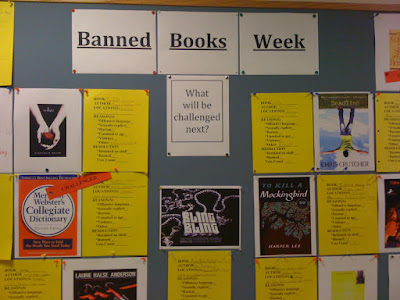
Banned Books Week in the Junior High


Paideia Junior High students, under the inspired leadership of teacher Sydney Cleland, have really run with their Banned Books Week investigations.


The ground level hallway sports 3 new bulletin board displays featuring covers and information on nearly a hundred books that have been challenged or banned in recent years somewhere in the United States.


In a stroke of genius, Sydney also included brown paper comment walls with leading questions for student response.


Tough question . . .


Which one would YOU save?

Tuesday, September 28, 2010

Caution: These Books May Be Dangerous


For many years, the American Library Association has designated the last week of September as Banned Books Week,
"an annual event celebrating the freedom to read and the importance of the First Amendment . . . Banned Books Week highlights the benefits of free and open access to information while drawing attention to the harms of censorship by spotlighting actual or attempted bannings of books across the United States."
Most of the books highlighted weren't actually "banned," but the alliteration of banned books week sounds much better than banned or challenged books or books somebody tried to get removed from the library week.

So this is Banned Books Week! I've created an eye-catching display of books in the library's collection that made ALA's "Top Ten Banned or Challenged Books" list at least once in the past five years. Lots of students, parents and teachers have stopped to read the information, and several have asked more about it.


I'd say we proudly own about 75% of the 40 or so books in those lists (a few repeat often, as they get challenged somewhere every year), and many many more that have been challenged somewhere. Many of them are popular books for teenagers -- a subversive group if there ever was one, and only the popular books (the Twilight series, Lauren Myracle's TTYL series, The Perks of Being a Wallflower, and good ol' Catcher in the Rye) get enough notice to inspire opposition. The most recent firestorm erupted just last week over Laurie Halse Anderson's Speak, popular since its publication in 1999.

The nature of our school is such that (knock wood) we've never had a formal challenge to any of our materials, though from time to time a parent will question why a certain book is in the collection, or why it's taught. We do have a materials collection policy that states why and how we add items to the collection, and should it ever be needed, a formal challenge policy and procedure.

The whole issue of censorship, the Freedom to Read, and the First Amendment is complex and tricky. As a private school library, we have a lot of freedom to select and not select, and a specific, well-defined community to serve. I spend time thinking about the "right" mix of ideas and viewpoints for our students. The Paideia community and approach to education means that many of the books challenged in more conservative communities are books that are perfect for our collection, such as those that present sexual orientation and identity questioning in a positive light. Author Lauren Myracle, whose TTYL books have hit the banned big time (on the Top 10 List 3 years running, #1 in 2009) has twice visited Paideia to talk to students.

But we don't have a collection of Christian fiction, or memoirs of notable conservative politicians, or more controversial and "other" side books like Holocaust denials or anti-global warming treatises. Should we? Where is the line between the librarian's responsibility to create and maintain a diverse range of viewpoints, and the responsibility to develop a collection that reflects the community's values and information needs? Many many kids have checked out The Geography Club, but not once have I ever had a request for Ann Coulter's books. Is it an appropriate use of school resources to buy a book if it won't ever get checked out?

This last week of September is a good time to be thinking about the freedom to read widely and diversely, how best to serve a diversity of opinion among a community, the courage to confront opposing and possibly repellent points of view, and the challenges of supporting everyone's Freedom to Read with the responsibility of upholding the rights and safety of the community.

Some of the library's most recent additions will be available in the Library Donation Sale this Saturday during the Fall BBQ & Dance. Please come visit, or browse the entire library collection using the online catalog. See you there!


More Banned Books Week reading:

15 Iconic Movies Based on Banned Books (Huffington Post)

Twitter: Banned Books New Best Friend
(NY Times)

Banned Books: Does Censoring a Kid's Book Remove Its Prejudices? (Huffington Post)

The Dirty Dozen: Twelve Books Guaranteed to Turn (Almost) Anyone into a Censor

Thursday, October 29, 2009

Learning 1-2-3

I do love Big Huge Labs' Flickr Toys, especially the Motivator poster template. I use it to create the regular Reader of the Month posters, I've used it to make cute poster of my kids & their friends, and occasionally other projects pop up. Sure, similar posters could be created with a draw program or Photoshop (if I could ever learn to deal with Photoshop . . .), but Motivator's just so easy and good-looking.

Inspired by a long research-based blog post, yesterday I created a new little poster. I'd never before thought about the learning process as a three-step, and I wanted to share. It just makes so much sense.


Even though this is just in black and white, it looks so much better printed on a color laser printer. If you're interested in having a higher resolution jpg (it's still not super, but better than what you'll get from the above image), please leave me a comment with e-mail and I'll be happy to send you the file.

The stick figure clip art is licensed from the Clip Art Gallery on DiscoverySchool.com, which has lots of nifty school-related clips art free to use for non-commercial purposes. Go check it out.


Creative Commons License

Tuesday, March 24, 2009

Why Good Librarians
are So Darn Nice

This spring, the faculty Library Committee is looking at student research skills in the JH & HS: what skills they should be learning, what they are learning, and how the library can help bridge whatever gaps there may be, either by teaching or supporting faculty as they teach research skills.

I've been reading up on national standards for high school students, and on the college student's research experience. We recently completed a survey of recent Paideia grads on their preparedness for college-level research; we're doing pretty well, they say, but there are always areas for improvement.

Two documents have been really interesting reading this week. First is the American Library Association's Standards for the 21st Century Learner, an outline of learning/research skills all students (and adults, for that matter) need to master for true information competency/literacy. It's much more succinct and snappier than Chapter 2 of 1998's Information Power, an earlier outline of "information literacy" standards from AASL.
The other is a progress report from Project Information Literacy. Entitled Finding Context: What Today's College Students Say About Conducting Research in the Digital Age. The description of the college students interviewed in this survey sounds not too different from high school students. They rely on Wikipedia for big-picture context when starting research (high school students also rely on SparkNotes for literature support); no matter how long is allotted for a research assignment, a majority will wait until the deadline looms to get started; and that settling into a topic, or "finding the right question to ask," is one of the hardest parts of the whole process (especially tricky since that's a first step and holds everything else up!). Here's what they said about libraries and librarians [emphases are mine]:

Students, who used libraries, looked to them, and especially to the reference librarians they consulted as sense-makers. Librarians helped students satisfice [ I learned a new word! It means 'make do with good enough'] their individual, often time sensitive, information needs. One student said, “librarians on this campus can be saviors, you need them to show you how to navigate a complex library system.”

Many participants considered formal library instruction (one-time, individual class visits) of little value to them, too. Throughout our sessions, participants reported that “library talks” (i.e., bibliographic instruction) made sense at the time, but that it was hard to recall and apply months later, when students were working on a research assignment. [the 'teachable moment' for these skills only happens when students have a burning need-to-know]

Other participants reported that they infrequently consulted librarians with the search terms they entered into scholarly research databases. Students told us “we are just as capable to enter basic search terms as librarians can,” “that I’ve been able to get by, so far, without librarians,” and “I don’t need a tour of the library, I just need to find one thing...now.” One student said, “my first step used to be the library, but it was too much information, now I just go to the Web.”

We found, generally, that when students did not receive (or request) the service they value delivered at the moment they need it from librarians, they quickly change course. Participants found a solution on their own, which is usually found online and derived from self-taught techniques that help them find the context they need. [Yikes!! The pressure!! :-)]

An ACRL (Association of College and Research Librarians) blogger wrote, rather pessimistically, that the report wasn't news to research librarians, and that what he took away from it was for librarians to keep on doing what we're doing. I have a little different take. What I read from it is that librarians who are successful in helping (and yes, teaching) students to conduct research absolutely must be available and approachable. We don't get a lot of chances to convince a needy student that the library is a dependable place to go for research needs. The ACRL blogger had it right, though, when he said it's all about building relationships.

I was heartened one day when, after explaining to a group of students that they needed to quiet down because "I'm mean and cranky," one student just looked at me and said (with a smile), "Yeah, right." Phew! There's hope yet. Ya' just gotta' love 'em (most days).