Thursday, November 14, 2013

Zombocalypse Now!
well, actually, really only just Thursday afternoon

Info and Links for High School Reading Club, November 14


World War Z  by Max Brooks

Max Brooks is the son of Mel Brooks and Ann Bancroft. He is also the author of  The Zombie Survival Guide.   WWZ is a sequel of sorts to the survival guide.

Max Brooks' website.


(ps -- he was only kidding)


Zombie Pandemic -- CDC's Zombocalypse Preparedness Graphic Novel!!
  • Follow Todd, Julie, and their dog Max as a strange new disease begins spreading, turning ordinary people into zombies. Stick around to the end for a surprising twist that will drive home the importance of being prepared for any emergency.

Max Brooks talks about the history and types of zombies
and how to survive in the event of a zombie pandemic.


World War Z official movie trailer - nothing like the book, stars Brad Pitt


Everything Wrong with World War Z In 6 Minutes or Less - by CinemaSins


Music & culture references 

Iron Maiden - The Trooper (Charge of the Light Brigade) - Battle of Yonkers
Redgum - I Was Only Nineteen (Vietnam, mentioned twice by 2 different characters) -
The Smiths - How Soon Is Now - creepy documentary soundtrack
Free to Be You and Me Babies & song (soldiers act out skit & sing) -
Johnny Clegg - Asimbonanga - ("have you seen him?" 2nd interview with T. Sean Collins)

Short film - Alice Jacobs is Dead

More Zombies in the Library


Discussion --
We talked about the role of women, how some people seemed to have gone crazy (the feral girl, Redeker/Xolelwa Azania, the downed female aviator who may or may not have communicated with someone in the bush who saved her).
Some were let down by the lack of a huge narrative arc (conflict, crisis, resolution) while others liked piecing together the action from the separate interviews. 
Some were frustrated by the fact that we never know exactly what happened to the boy in China to start the pandemic -- we talked about the parallels with the spread of H1N1/swine flu in 2009, the exact origins of which we can only guess.
We jumped off of some of the questions in this blog post.

Next Time
We're reading Beautiful Ruins  by Jess Walter.   Meeting will be on Thursday, January 9.

Tuesday, November 12, 2013

f0r}P3+3]sS@k#!:
Guard Your Online Info with a Strong Password


Earlier this fall I mentioned that I'd spent part of the summer reading all the detective/mystery novels by Michael Connelly. One of the novels, The Scarecrow (borrowed from the DeKalb Public Library's ebook collection), features a very, very bad guy who is also a computer security expert.   I was alarmed at how easily this bad guy was able to break into various characters' email and bank accounts, destroying their finances and careers by altering and deleting vital information.   My passwords have been reasonably ok, but since The Scarecrow, I've been going through and upgrading all my passwords, starting with email, and anything that has financial information involved (bank, PayPal, Amazon.com, mortgage company, iTunes, etc etc).

 AARGH!! How can anybody come up with strong, unique passwords for every single dad-blamed website (because, of course, you have to have a username and password for EVERYTHING, from PiBites to updating your directory information, all on different platforms with different accounts.)

Fortunately, Gwyneth Jones, The Daring Librarian, has come up with a nifty comic tutorial encapsulating all the sage advice on creating unique, strong AND rememberable* passwords for all your sites.  In a nutshell:
  • 1. Make your password at least 12 characters long.
  • 2. Make it complex -- use a phrase (not just a dictionary word) with special characters,
    numbers and both upper and lower case letters
  • 3. Add to your main passphrase characters that make it unique for each site (for instance, the
  • first three letters of the site name, backwards) so you have to remember only one complicated phrase, and the site reminds you of the rest.
     
Can you guess the passphrase in this post's title? It's  f0rP3+3sS@k#!  (for petes sake!).  Vowels are from the number line, spaces are brackets }, and the "t" was replaced by a plus sign.  It looks completely random, but you and I know the secret to remembering it.

The complete tutorial is in the graphic below, and you can download a higher-resolution printing copy of the file from Gwyneth's Flickr site. Post it on your office bulletin board or next to the computer  -- but f0r}P3+3]sS@k#! don't write your passphrase on it!


Of course, you also have to figure out all the zillion sites where you've had to set up accounts over the years, but I can't help you with that.

Check out the rest of The Daring Librarian's 10 Super Geeky Tips for the New Year on her blog.

Are you using lame passwords?  Do you have any additional password tips?  Share in the comments!


* "memorable" is for dates and fabulous novels. "Rememberable" -- able to be remembered -- is a much better for this purpose :-)

Wednesday, October 30, 2013

Halloween Horror

It's to be expected that creepy things tend to show up around the last week of October, and I've had a few creep-outs this week.   In order --

World War Z: An Oral History of the Zombie War  by Max Brooks.   Truth is, I'm enjoying this book so much more than I thought I would.  I have never gotten the zombie craze -- they're just so gross, and I went off horror in about 1990.  It might actually have been Night of the Living Dead that did me in. Ugh.  But -- as an "oral history," in World War Z, I can be assured that at least none of the people I'm reading about will be eaten by zombies (because they're being interviewed, I already know they've survived! I am bracing myself for something horrible to come, though). Plus, I enjoy the puzzle-quality of creating a continuous narrative out of the separate experiences of many many individuals.  I'm looking forward to the reading club discussion in a couple of weeks.

Next, while looking around for a short scary film to show for Halloween, I came across Alice Jacobs is Dead: A Love Story,  a 21-minute film about Ben Jacobs, the celebrated scientist who created a cure for the Z-virus, and how he manages to use his life-saving serum to destroy all he'd worked to save.  I watched it yesterday -- I confess to covering my eyes at the "extra zombie gore!" part, but I heard every bit -- and am haunted by it.    How far should science pursue an answer? What exactly is living death?  At what point does love move from selfless to selfish? Watch the trailer on YouTube. You can borrow the DVD from the library (if you dare . . .)

No Halloween is complete without a heaping helping of Edgar Allan Poe, and today was the day I came across this video rap version of Poe's The Pit and the Pendulum.  It's catchy, creepy, and the visuals prod the imagination just enough.


Another slowly creepy short film is The Facts in the Case of Mister Hollow, an exploration of a single photograph hiding a terrible deed. As the camera begins to investigate the photo, it reveals a tapestry of secrets hidden in the details, and a tale of murder, kidnapping and sacrifice captured in a haunting moment.  Eeek!


Shiver. I think I'll go watch something charming and happy to take the creep off.  Happy Halloween!!

Tuesday, October 15, 2013

Thumbs Up for Mr. Penumbra:
October Reading Club Meeting

The High School reading club met in the library last Friday to discuss Mr. Penumbra's 24-Hour Bookshop, the 2013 Alex Award novel from Twitter "media inventor" Robin Sloan, which all attendees really enjoyed.  This post originally went up as a way to display info about the book during the meeting -- I've added commentary about the reading club discussion and what the various bits and pieces mean.
>>>

Some background on the author

Author Robin Sloan writes about himself on his website:
I grew up near Detroit and went to school at Michigan State, where I studied economics and co-founded a literary magazine called Oats. Between 2002 and 2012, I worked at Poynter, Current TV, and Twitter, and at all those places, my job had something to do with figuring out the future of media.

I’m the author of Mr. Penumbra’s 24-Hour Bookstore, which started as a short story right here and is now a full-length novel from Farrar, Straus and Giroux.

I believe that stories told primarily (but not exclusively) with words are among the most durable things a person can produce, and I’m trying my best to write a few that might make it through to the year 2112. If you read one and pass it along to someone else, you’re participating in that project—so, thank you!

>>>>

We watched part of this talk (embedded below) by Robin Sloan, starting at about 4 mins 24 secs, and going to about 10:05.  In this part he talks about how he gathers ideas, his approach to writing, and the philosophies of "lightness:" of inspiration, of motion, of digital, and the lightness of AND.

After the clip, we looked for expressions of these lightnesses in the book --
  • the initial inspiration for the short story, which later became a novel, sprang from a Tweet -- "thanks to Rachel Leow for a tweet on November 15, 2008: “just misread ‘24hr bookdrop’ as ‘24hr bookshop’. the disappointment is beyond words.”
  • Sloan's Latin motto, Solvitur Ambulando, "it is solved by walking" connects to the Unbroken Spine's motto Festina Lente, "make haste slowly"
  • digital is everywhere in the book, from Google to Skype, to FaceTime to digital scanners and on and on.  In addition to the online short story, Sloan has also penned a Kindle Single short novella, Ajax Penumbra 1969.  This backstory of a seller of ancient books is only available as a digital download, but the cover of the physical book glows in the dark!  It's just not the same on an electronic reader . . .
  • and of course, the whole book is about the "Lightness of And."  Digital and paper, the past and the future, people and machines, art and engineering. And . . .

Why We Should Leave Our Fingerprints For the Future 
-- Robin Sloan (DoLectures, January 2013)


>>>

Even though Clay Jannon is the narrator and presumably the central character of the novel, he took up very little of our conversation.  Mr. Penumbra is the star of the story, and Mat, Kat, Neel and a few other characters are more vibrant and attention-catching than Clay.  Penumbra means "almost a shadow,"  and we talked about how Mr. Penumbra is a bridge between the old ways and the new. Clay is also a bridge, between Mat's art and Ashley's perfection,  between not-exactly-a-feminist Neel and women's art, between Mr. Penumbra and the digital future. Most importantly, he's an ordinary everyday guy who's the  catalyst for amazing events and discoveries.


>>>

A couple of renditions of the symbol of the Unbroken Spine.


>>>

There is no pub in New York called the Dolphin and Anchor (though there ought to be), but the real Aldus Manutius used an emblem of a dolphin wrapped around an anchor, and the motto Festina Lente, as his printer's mark.  Aha! someone in the group said -- dolphins are speedy and anchors slow you down.


>>>

What's the relationship between a modern day CV (a scholar's Curriculum Vitae) and the codex vitae written by Unbroken Spine scholars?  What's a codex?

>>>

The one thing I'm kicking myself for is not realizing soon enough the possibility that Robin Sloan might do a Skype visit with the club.  He says right on his website that he loves that opportunity.  Drat and double drat!  Perhaps we can have a special "encore" meeting with the author???

>>>

Stay tuned for the next reading club selection.  We're choosing among Beautiful Ruins, The Art of Racing in the Rain, Where'd You Go, Bernadette?, World War Z, and The Hitchhiker's Guide to the Galaxy.

Friday, October 11, 2013

Chick(en) Lit in the Library


Last weekend's Library Donation Sale was set up in the Art Lobby, and one of our walls was a show of tissue paper collage hens by an elementary art class.  Being a chicken-lover myself, I enjoyed being in 'hen hall' for a couple of days.

Of course, this made me think of our Urban Farm program at school, and the many resources we have in the library to support that learning program.  We have pretty much everything you need to know to start a farmette, including several books (and a video) on raising chickens.  

Titles include:

Foreman, Patricia L. City Chicks: Keeping Microflocks of Laying Hens as Garden Helpers, Compost Makers, Bio-Recyclers and Local Food Suppliers (how's that for an enthusiastic title??)

Kilarski, Barbara. Keep Chickens: Tending Small Flocks in Cities, Suburbs and other Small Spaces.

Weaver, Sue.  Chickens: Tending a Small Scale Flock for Pleasure and Profit.

and a DVD:

Fred's Fine Fowl.  Regarding Chickens (171 mins.)

Do you have chickens, or wish you did?  Recommend any other great resources in the comments!

Monday, October 7, 2013

Creating Powerful PSAs

For Magnus' Biology 2 class


A PSA ("Public Service Announcement") is a "message in the public interest disseminated by the media without charge."  In other words, it's an advertisement with information for the general public, run for free on TV, radio, billboards or magazines.

What the definition doesn't say is that a PSA has to be:
  • short
  • powerful
  • important

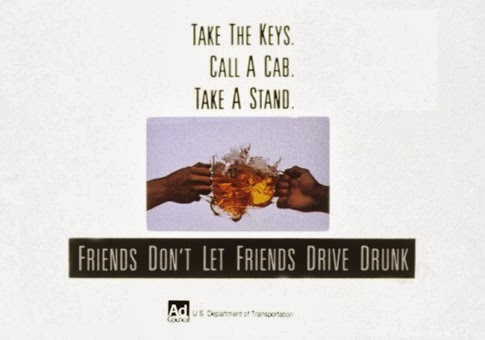
Do you recognize any of these images?


They're some of the most famous PSAs of the last century.

How about this recent radio PSA from the CDC -

Tips for creating a great Public Service Announcement ---
  • Know your GOAL - to get people to take a specific action (stop littering, wash hands, stop texting while driving)
  • Talk about RESULTS - a beautiful countryside, not getting bird flu, not causing a car crash)
  • Use informal EVERYDAY LANGUAGE (not lit writing or police speak)
  • Use EMOTION
  • Make it PERSONAL
  • Stick to ONE MESSAGE
  • Remember that SOUNDS CREATE PICTURES.  If you use sound effects or music, it must make the right picture in the listener or viewer's mind.
  • Keep it SHORT.  30 seconds is very common. 
  • IDENTIFY the sponsoring organization. 


Resources

How to Create the Perfect Public Service Announcement (Center for Digital Education)

How to Write a Public Service Announcement (pdf, from Kansas Association of Broadcasters)

Public Service Announcements (Wikipedia article)

Distracted Driving video PSAs (The Hill)

Sound Effects clips

Sound Bible (wav & mp3 files)
FreeSound (wav files)
Big Sound Bank (wav, aiff, mp3s; a French site)
FreeSFX (mp3s)

Saturday, September 28, 2013

fREADom to Read in the Junior High

In recognition of national Banned Books Week, fabulous junior high teacher Sydney Cleland organized and MCed a great community time program on Friday morning.   With an introduction on the recent history of challenged and banned books (ALA has a great timeline called "30 Years of Liberating Literature"), we talked about the difference between a book 'challenge' and a book actually being 'banned' (Banned Books just sounds so much better, but it's not nearly as common as the number of annual challenges), how librarians and libraries have a professional responsibility to protect their patrons' First Amendment right to free speech, and how 'even at Paideia!" we have a policy and a procedure to follow in case somebody challenges a book one of our libraries (yes, Virginia, it happens even at Paideia).


The stars of the show, though, were members of the junior high debate team (coached by Greg and Uri).  Pairs of debaters argued for and against book banning in general, and then for and against specific, often-challenged books, including the Harry Potter series, To Kill a Mockingbird and Are You There, God? It's Me, Margaret. 

You can't see it very well in the photo, but the caption is

FREADOM

At the end of the program, I handed out bookmarks.


Want to read a banned book??  There are so many to choose from  in the Paideia Library.  Be a rebel -- read a banned book!